Category Archives: Character

5 Friday Faves – Joni’s 50 Years of Quadriplegia, Lord of the Rings Guitar Cover, a Low-Carb Surprise, Blindspots, and Taking Responsibility

Friday! This time of year, it’s squeezing out those last vacation days before school starts again (after Labor Day in Virginia). Many of our friends in other states have already shut down their summer as kids  returned to school this week. Can’t you just smell the fragrance of new school supplies? For us here, it’s still making hot August day memories with little guys.

While you finish your cup of coffee or break from work, let’s get down to this week’s Friday Faves.

1) Joni’s 50 Years of Quadriplegia – A woman who has taught me much about living through hardship with grace is Joni Eareckson Tada. She is a writer, speaker, artist and advocate for persons with disabilities. More central than all of that is her deep faith and dependence on God…especially in the 50 years since a diving accident, at 17 years old, put her in a wheelchair for life. I discovered her through an old feature film and her autobiography – Joni: An Unforgettable Story. The testament of her life points always to a God who gave her the grace to “count quadriplegia joy“. She is an amazing woman empowered with His love and that of those by her side, especially her husband, Ken Tada.Photo Credit: Joni and Friends

In Awe of Her God – Joni’s Fifty Years of Counting Quadriplegia Joy

Reflections on the 50th Anniversary of My Diving Accident – Joni Eareckson Tada

Joni and Friends

2) Lord of the Rings Guitar Cover – One of the feature films with the greatest impact on our family is The Lord of the Rings Trilogy. The stories are gripping; the heroes are the stuff of legend; the villains are loathsome; the music is spectacular. Nathan Mills, Beyond the Guitar, has finally given us an arrangement of one of the great themes: Riders of Rohan from The Two Towers (second film of the trilogy). You can hear the theme in context with the story here (music rises after minute 5).

Nathan’s arrangement is here…and all us LOTR fans loved it (126,000 views and counting).

3) A Low-Carb Surprise – Earlier this week, we had a big supper with friends. A regular event where we take turns bringing food to share. This amazing cook in the bunch made loaded mashed potatoes. Having just finished a sugar detox, I have minimized carbs in my diet for over a month. Those mashed potatoes were so yummy. Not really ready to dive into unrestricted carb eating, I’ve been doing something very different (and appalling for me). Substituting cauliflower for potatoes and rice. Here’s the surprise. I’m shocked to confess that cauliflower is actually good…enough. With a lighter carb load and other nutritious qualities as well. Last night I made Shepherd’s Pie with a cauliflower topping. I don’t food-process the cauliflower; just steam it and then either mash it or crush it a bit with a fork (to use as rice).Cauliflower takes on the flavors added to it. Just as with mashed potatoes, butter and a bit of milk completed the substitution. Cheese on top and…hello!

Still…the next time it’s my friend’s turn to cook, that mashed-potato queen, I will not be slow to take my serving. Low carbs, not no carbs.

YouTube Video – This Is Why Eating Healthy Is So Hard (Time Travel Dietician)

4) Blind Spots – Life coach and writer Martha Beck defines blind spots as psychological “aspects of our personality that are obvious to everyone but ourselves“. She even prescribes a way to discover them.

“I know how valuable honest feedback can be, how much precious time it can save in my struggle to awaken. I still have to force myself to go looking for it, but when I do I almost always benefit.

Try this: For a week, ask for blind-spot feedback from one person a day, never asking the same person twice. Just say it: “Is there anything about me that I don’t seem to see but is obvious to you?” You’ll probably want to start with your nearest and dearest, but don’t stop there. Surprisingly, a group of relative strangers is often the best mirror you can find. I’ve worked with many groups of people who, just minutes after meeting, could offer one another powerful insights. Like the emperor in his new clothes, we often believe that our illusions are confirmed by the silence of people who are simply too polite to mention the obvious. Breaking the courtesy barrier by asking for the truth can change your life faster than anything else I’ve ever experienced.”Martha Beck

As hard as negative feedback is to stomach, it is a great help to avoid continued odd responses from people or the distancing that can happen when our blind spots get in the way of intimacy and care in relationships.Photo Credit: Vimeo

Now blind spots and “buttons” are different and yet connected. Buttons – those things people do that make us crazy – actually point to some of our blind spots in the way we respond to people pushing those buttons.

For instance, one of my buttons is when someone treats me like I’m stupid, or gullible. Like when a person tries to help me understand a decision he/she has made as if it’s a good thing when I know, and he/she knows, it’s not necessarily a good thing for me. This sort of thing makes me really burn (standing in the need of prayer here). OK…that’s a button, but my response reveals a blind spot. My blind spot is that if I take a stand in some area then it means that I am totally right in that stand. Sort of the same as the button but from a different direction, you know what I’m saying? It’s helpful to know our blind spots and our buttons so we can work out ways of being more honest and honoring in our communications.

What do you think?

Seeing Your Emotional Blind Spots – Martha Beck

What’s Your Blind Spot – Jane Taylor

6 Career Derailing Blind Spots and How to Overcome Them

How Successful People Cure Their Blind Spots – Kevin Kruse

How to Watch Out for Blind Spots in Your Leadership – Lolly Daskal

5) Taking Responsibility – You may be starting to expect in pretty much every Friday Faves that you’ll see a guitar arrangement by Beyond the Guitar and a life hack by Benjamin Hardy. You could be right. This week, Hardy posted an article on taking responsibility – What Happens When You Take Full Responsibility of Your LifePhoto Credit: Lakenheath

He talks about the hazards of indecision. Taking responsibility for our lives means to make decisions based on where you are and where you want to be at some future time. Life isn’t meant to happen haphazardly. Yet, because of our fear of failure or insecurity about making good decisions, we default to not making the decision. Then we languish in our current situation, losing ground even…rather than taking hold of our life and moving it in the direction we believe it’s meant to go.

Commitments are important to make and to keep. When we commit to something publicly, we have even more impetus to do what we’ve said we will do. This isn’t shaming or guilting…this is operating as a mature and responsible individual. These kinds of commitments also grease the tracks for success in that expressed decision.

Making a commitment means you’re seeing it through to the end. It means you’re leaving yourself no escape routes. You’re burning any bridges that might lead to lesser paths of distraction. Your decision has been made. There’s no going back. You’ve passed your point of no return.

Where decisions are made in a single moment, commitment is seeing those decisions into the future. Especially when life gets difficult. – Benjamin Hardy

A friend made the statement “You fake it until you make it.” I’ve heard that spoken before but never by her. “Faking it” is something that doesn’t fit this incredibly wise and reasoned woman. What she further explained though brought the meaning. So what if we aren’t sure of ourselves in the decision. What if our desire is to commit to something but we aren’t sure we can actually follow-through. Then we “fake it”, or really, in her further explanation – “You walk the talk until the talk becomes your walk”.  Make the decision; execute the decision.

Make the decision you want to. Eventually, you grow into that decision through your commitment and personal resolve. Your goals are something you grow into.

This isn’t faking anything.

It’s living with intention.

It’s living with definiteness of purpose.

So what’s the challenge?

Publicly commit to something to TODAY.Benjamin Hardy

Thanks again, Benjamin Hardy…and Nathan Mills…and all of you have a safe and restful weekend. Live with intentionality, and be kind to yourselves. That kindness will splash out on others.

Monday Morning Moment – Are You Listening? Or Are You Silencing Voices?

Photo Credit: Flickr

Let’s start on the grandest scale possible. Even the God of the universe invites us to speak to Him…and He listens and actually hears us.

Something to aim for with each other…on the smallest scale of our lives.

We love when little babies recognize our voices as attached to people they have grown to know and love in their short lives. Then they discover their own voices, and we celebrate that milestone. That magical power of making their observations and requests understood must be life-changing for them…and for us.

At some point, years down the road, we begin to tune out a little…and we model it for them, farther down the road.

This “tuning out” is why courses in active listening abound in universities, and not just in the communications department.

In our adult lives, of work and community, we are wise to take a measured look, from time to time, at how we listen and whether we silence the voices around us by our behavior.

Leadership coach Kate Nasser posted a bold article on the workplace scenario of silencing employees.

She doesn’t hold back on leaders’ responsibility in this, but I view this as applicable to any part of our community, whether it be marriage, family, friendship, or religious/political affiliation. A brief summary of Nasser’s 15-point checklist follows:

  1.  Look unapproachable.
  2.  Have a thin skin and make it about you.
  3.  Do not ask for input.
  4.  Bully and berate others or their ideas.
  5.  Speak only to those who make you comfortable.
  6.  Ignore ones who raise issues.
  7. Create a hierarchy of those you speak with and those you don’t.
  8.  Claim you want innovation but demand proof during the creative phase.
  9.  Take credit for others’ ideas.
  10.   Accuse and blame in public.
  11.   Nit-pick on details when ideas are first offered.
  12.   Change the subject without acknowledging what was said.
  13.   Pit one person against another.
  14.   Override every decision others make.
  15.   Lead chaotically with constant exaggerations and untruths.

Insidious Leadership: Are You Silencing Employees? – Kate Nasser

Whew! That was rough, huh? None of us are probably characterized by all those points. However, did any of them smart a little? We don’t want to be that kind of person…probably none of us…that kind of person who, by our behavior and attitude, silence another person’s voice. We all lose when that happens.

Dealing with our realities helps us to listen actively. Our realities may include over-work, weighty responsibility, and seemingly inadequate freedom or resources to make change. Don’t we want to be active listeners…to gain from those around us and empower them to be successful? We can become effective listeners again.

YouTube Video – The Power of Listening – William Ury – TEDxSanDiego

We may think we are good listeners. We make eye contact. We “give face” to those around us. However…hear this. Do others’ ideas make us tired? Do we have a strong grip on “the way it is” and have no intention on giving way…no matter how well we think we’re listening. Author and mediator William Ury (see TED Talk above) speaks of true communication through “a listening revolution”. First we listen to ourselves to discover our own desires, dreads, and dreams. Then we learn how to listen with understanding and with the determination of acting on what we hear. Actually, listening, with the goal of understanding, is the first action we take.

“Give them our full attention and listen to the human being behind the words, because one of the biggest gifts we can give anyone is the gift of being heard.”William Ury

Photo Credit: Flickr

I’ve had more experiences than usual with doctors over this past year. As we all know, they have the reputation for not being “good listeners”, for not “giving voice”. I can tell you the ones I hope not to see again or the ones who are visibly backing out the door before my questions have been answered. There are still others who “give face” – eye contact and a seemingly engaged look (from years of practice maybe) – who have clearly still moved on to the next patient, even while still standing by my bed.

Then…there is the one or two – those beloved physicians – who actually sit by us, in the exam or hospital room. They treat us as if we’re the only patient they have that day. We talk together, and I know that we are partners in keeping me healthy. Right? Partners – not the greater and the lesser actors in a scene, but partners.

Kudos to you out there – physicians, bosses, colleagues, spouses, parents, children – who don’t just have the look of listening or communicate some sort of nuanced “I hear you”. Kudos to you who really listen and engage with the other.

We are not all just a set of ideas or opinions. Real people bring a voice to the table. When we communicate that we are too busy or too important or too settled already on a decision to consider one more voice, we speak volumes about our own character…and eventually the product or service we have to offer.

[I’m preaching to myself here…reminded of the God of the universe who takes the time and action to assure us that we will be heard… when we speak to Him. Sometimes, I cry out to this small world of mine, demanding to be heard…when there is a place, a Person, who always welcomes me. Please forgive my waxing a bit philosophical or theological. For me, it’s a good place to start in 1) sorting out what exactly I want to voice, and 2) practicing listening to another with the same honor/respect I wish for myself.]

We are not just the ones who silence voices or the ones who feel we are not being heard. We can be both, and usually are.

Listening, determined to understand, brings us closer to both leading well and following better. Something to think about on this Monday morning.

Don’t miss the links below. Really excellent reads on how we silence one another’s voices and how to we turn it around.

Insidious Leadership: Are You Silencing Employees? – Kate Nasser

Can Your Employees Really Speak Freely? – James R. Detert & Ethan R. Burris – Harvard Business Review

6 Reasons Employees Must Speak Up to Thrive at Work – Glenn Llopis

7 Tips for Wooing Your Employees Into Loving Their Jobs, Again – Matt Straz

Monday Morning Moment – Ignoring in the Workplace and the Powerful Practice of Noticing – DebMillsWriter

Monday Morning Moment – Workplace Wisdom – From the Shallows Back Out Into the Rapids – 5 Resources

Photo Credit: Wikimedia Commons

The river of work is often a fast current – the movers and shakers are in the rushing waters. If you find yourself in the shallows how did that happen? Illness (yours or someone in your family), underemployment, qualifications issue, somehow just not the “flavor of the month”? Any or all of these situations could have prompted a detour out of the faster waters of your work.

Some of us thrive in the shallows. I want to learn how, now that I’m semi-retired. Still, the rapids call me  back…for many reasons.

If you, like me, are in the shallows and you are bewildered rather than refreshed by them, think why that might be.

The rushing waters are where the action is. They’re here and gone, but they carry along whatever is happening in the river.

Occasionally something interesting and important will pop out for you from the current – and you tackle it with excitement – and when you finish it, then it’s gone. Taken back up by the river as if it never visited the shallows, as if you never touched it.

The shallows are a lovely place to visit…especially when you’re exhausted from the rapids. Especially when you need a new vantage point…a new view of your work. The shallows provide that. Being long in the shallows is a strange experience…if you’re used to the rapids.

How does one push back out into the current?

OK…enough metaphor. Here are 5 super useful resources to help us push back into the running river of work…if that’s where we want to be. Choose which fits the most right now, and dig into the article:

1) Achieving Stadium Status – Why not have a colossal goal, right? Leadership consultant Skip Prichard posted a piece recently on How to Achieve Stadium Status. Photo Credit: Wikimedia Commons

He gives a hardy review of John Brubaker‘s book Stadium Status: Taking Your Business to the Big Time. From the book, Prichard covers such topics as how to use affirmations, dealing with critics, rising above the noise, leaving our comfort zones, avoiding comparing, and not repeating others’ mistakes. Until you can read the book, catch Prichard’s article to get started toward the main stage.

Stadium Status: Taking Your Business to the Big Time – John Brubaker

2) Bouncing Forward After a Big Fail – One of my favorite writers on leadership and the workplace is  Adam Grant . He takes a very different view of failure at work in his article When You Get Fired Or Fail Big, This Is How You Bounce Forward. Photo Credit: Pexels

Quoting Grant here:

“Most of the time, when someone fails, it’s not because there’s a bad apple spoiling the barrel. It’s because the barrel is a bad relationship.

In other words: It’s not me. It’s not you. It’s us.

That doesn’t mean shirking responsibility or failing to hold others accountable. It means realizing that in many of our struggles, the biggest problem lies not in individuals but in relationships.

It helps to remember that in most failures, relationships are a major factor. We just have to make sure we don’t pull the wool over our own eyes.” – Adam Grant

Option B: Facing Adversity, Building Resilience, and Finding Joy – Sheryl Sandberg & Adam Grant

3) Addressing Team Alignment – Leadership trainer Jesse Lyn Stoner looked at how team alignment influences team performance. In her piece, Team Alignment is for the Birds, she had this to say:


Team alignment is often “leader dependent. Followers depend on the leader to make decisions on direction and tell them what to do.

Team members [in this scenario]. . .

. . . should not act independently.

. . . have little need to communicate with each other.

. . . are following the leader, with no idea where they are going.

We need teams composed of individuals who are able to make quick decisions on how to respond to what comes their way, who are able to use their good judgment to solve problems, who coordinate their efforts with each other, and who come up with fresh new ideas.

A compelling vision (that includes common purpose and shared values) is a more powerful way of unifying your team than trying to align them through structure, policies and procedures.

When a team is organized around a unifying vision, the vision becomes the glue that holds your team together.” – Jesse Lyn Stoner

6 Benchmarks of High Performance Teams – Jesse Lyn Stoner

4) Excellence in Execution – Strategy thinker Robin Speculand writes on what it takes to effectively implement change. In his blog (guest post on Skip Prichard’s website), Speculand talks about the role of the leader in driving strategy forward. To effectively execute change, leaders must demonstrate their own commitment to the strategy. How visible they are to the rest of the company’s employees attests to how valuable the execution of that change is to them personally. Speculand talks about how to carve out time and energy from a busy schedule in order to be fully available to those most impacted by the strategy change. Photo Credit: All Hands

Intriguing ideas, especially for any of you in the shallows. To be a person who executes well is a valuable employee. Don’t lose sight of that.

A Leader’s Role in Achieving Excellence in Execution – Robin Speculand

Excellence in Execution: How to Implement Your Strategy – Robin Speculand

Robin Speculand Presentations – Slideshares

5) Becoming More Likable – Work is not a popularity contest. However, likable people are just a whole lot more fun to work with than folks who insist on being controlling or contrarian. Marcel Schwantes lays out 6 qualities of folks we would all like on our teams…

  • Be curious and ask interesting questions.
  • Describe other people in the positive.
  • Make an immediate good first impression with your face.
  • Listen. Really listen.
  • Choose every opportunity to experience joy.
  • Don’t pass judgment.Photo Credit: Flickr

6 Qualities of Extremely Likable People, According to Science – Marcel Schwantes

Bonus: a Critical People Skill with Kate Nasser

A Critical People Skills Moment to Handle With Ease – Kate Nasser

When others ask you to change a behavior that rubs them the wrong way, what is your response? They will remember how you reply to this critical people skills moment.

Do you …

  1. Give a list of reasons why you do it?
  2. Ask them to explain why it bothers them?
  3. Suggest that they are being demanding, irrational, unprofessional, or childish for asking?
  4. Take offense and avoid these people whenever possible?
  5. Stop doing it?

Check out Kate Nasser‘s lightning fast read on looking seriously at the 5th response above. We want our preferences…we want things done our way. We want “me” to win, not “we” to win. Something to think about.

Let’s push out into the fast water of our workplace…we’ve had enough time in the shallows.

Monday Morning Moment – Grit – the Role of Personal Resolve and a Team Alongside

[Adapted from the Archives]

Diligence is a word that defined my many years in learning Arabic while we lived overseas. Keeping at it, even when I wanted to quit, helped immensely. The joy of living life in a second language is worth all the work. Diligence is a great assist to staying on course, but it is not “grit”.

Once on a beach weekend, I saw grit at work in a group of servicemen, in Virginia Beach, doing their morning exercise. [Not the picture above but that image has its own neat story of grit]. Walking on the boardwalk early in the morning, my husband and I encountered this small group of airmen from the nearby Naval Base, doing a group jog. We saw them starting the run and saw them again coming back – 6 miles total. Most of them were young, thin, and fit.

What caught our eye, in particular, were two men in mid-life, carrying a bit of weight, bringing up the rear. Approaching the end of that run, they looked like they were hurting, but they definitely weren’t quitting. I’m sure to stay as fit as the rest of the group was, a certain measure of grit was at play…but these two, in this snapshot of life, showed the grit that brought me to write today.

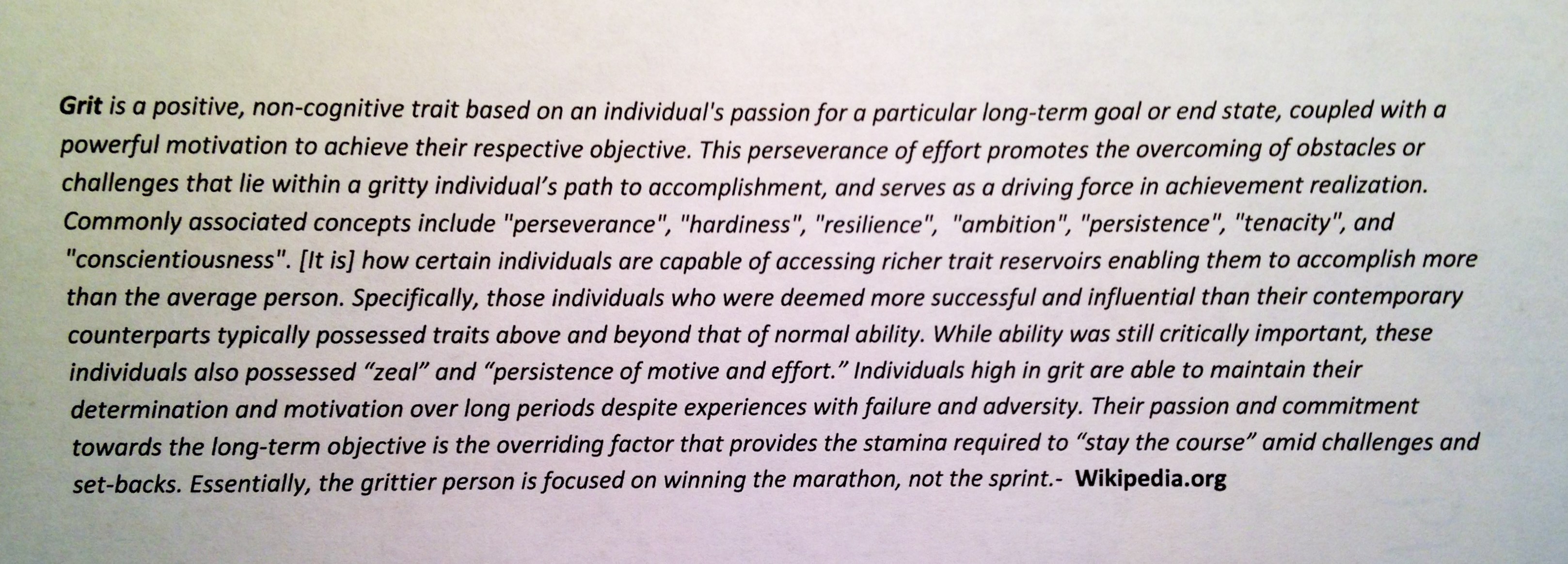
Wikipedia.org defines grit as a character trait  of applying passion and perseverance over time toward a goal, end state or objective. Grit goes beyond ability and can withstand failure, keeping the end goal in sight, and pushing through to it.Blog - Grit - Definition 2

Bill Hybels, at the Global Leadership Summit 2015*, talked about grit as “one of the greatest indicators of success”. Gritty people, he said, are the ones who “play hurt” and rarely ever give up. “They expect progress to be difficult, but believe with their whole being that they can be successful if they don’t quit.” It’s “The Little Engine That Could”. Abraham Lincoln. Nelson Mandela. Gandhi. Martin Luther King. Hybels also encouraged the audience that grit can be developed. From childhood through adulthood.

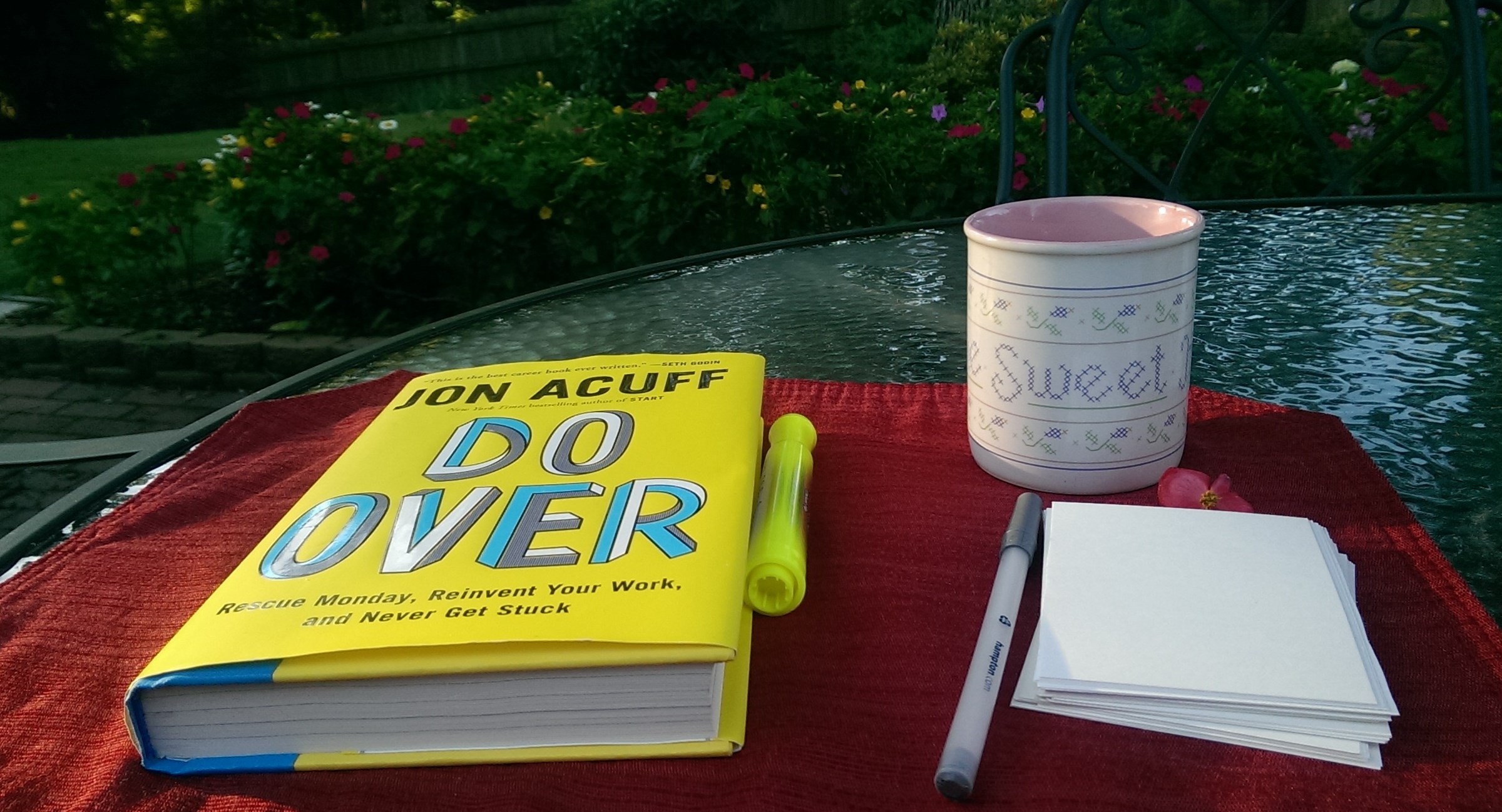
Jon Acuff (author of Do Over) defines grit as “stubbornness in the face of fear“.  In his book, he gives a short list of what’s needed in making gritty decisions (in the “hustle” of work):

  • Time – we think the world “hustle” has to mean fast, but it can also mean focus, intention, pace.
  • Counsel – Lean on your relationships. Some of the worst decisions are made alone. Who are your advocates? Have you given them time to reflect on it or are you rushing right by the wisdom they have to offer? Let them speak into it. A year from now, looking back on the decision, you’ll be glad you made it as a team.
  • Questions – Always ask awesome opportunities, awesome questions. We skimp on due diligence. “What am I not seeing right now?”
  • Kindness – Give yourself permission to make the wrong decision, because…you’re going to. Break the tension of feeling like you’re going to be perfect by giving yourself some kindness from the outset.
  • Honesty – When you look back on a decision, remember that you made that decision with the best information you had at the time.

As we saw those two older heavyset men running just behind their younger airmen colleagues, we saw men with a goal in mind. There was also something more – the cadence to the group’s run that seemed to work to keep them all together. Whether at work or in family relationships, we want to do all we can to help those gritty ones be successful. Their resolve may get them to the goal anyway, but we all benefit when we are able to “stay on course” together.

Have you “grown gritty” over your lifetime? Are there gritty folks in your life who you love to champion? Please share in the Comments below so that we can all learn.

*Session 1: Bill Hybels Opening Session – Global Leadership Summit

Wikipedia Article on Grit

The Truth About Grit

The Grit Test

Jon Acuff on the Role of Hustle in Taking Hold of Career Opportunities – Notes & Quotes – Part 5 of Do Over Series

How to Make Grit Decisions and Built a Grit List by Jon Acuff

Do Over: Rescue Monday, Reinvent Your Work, and Never Get Stuck by Jon Acuff

Does Teaching Kids To Get ‘Gritty’ Help Them Get Ahead?

Monday Morning Moment – When Connections Are Lost – a Rant, a Resolve, and a Request

Photo Credit: Pixabay

Here written is a cautionary tale…one with a happy ending to follow.

Across my professional and personal life, I’ve experienced a great wealth of teams, affinity groups, communities and networks. Real flesh-and-blood people gathered passionately around products or services. People who trusted and enjoyed each other, who used their influence to do good. People who expanded both their influence and ability to do good by holding doors open to others with like vision.

…and I got to be a part of all that. It was an incredible life…and I want it back.

This is not to say that my life is lacking. That’s the rub. Life is amazingly good right where I am…wait for it…but, (such a small word that screams discontent, right?). There is something that has faded, and it can for you as well, if you’re not aware and nurturing it. Don’t let it happen because it’s too valuable.

What I have discovered over the last year is that the wide-reaching, lively connections in my work and personal life have been lost…or, for sure, diminished. This is what I’m determined to correct.

You know that odd experience when you lose a phone conversation (either because of passing through a cell service dead zone or you hit the disconnect button). You or the other person continues talking for a bit not realizing the other person is not listening…has left the conversation (intentionally or not intentionally)…and once re-connected, if you’re able, you have to awkwardly figure out where you left off.

Lost connections are jarring because they interrupt a process of communicating, collaborating or cooperating together on something of value.

Human capital is when you are connected to different individuals who have the capacity and desire to do good together (in creating or innovating – a product or service). Social capital – that of teams, agencies, or other communities working together – is an even larger, richer commodity than individual human capital.

I wrote about social capital previously here.

Social capital is the willingness of people to help each other. It often replaces money which people would use to buy the same help. Most ways of measuring social capital have to do with trust – people who trust that favors and help will be available when they need it will favor and help others more. Social capital is a lot like real capital. The more money a person or a society has, the easier it is to do things and the better off people are.Simple English Wikipedia

Photo Credit: IResearchNet

Through a variety of circumstances in recent years, I have lost some social capital. Reflecting on this real situation has been very helpful and motivating for me personally.

Jon Acuff, in his book Do Over, talks about the importance of not burning bridges when we leave a job or affiliation. I’m a bridge-builder not burner, but bridges can break down, through neglect or vision change and resource realignment.

At times, the sheer force of too much change can cause connections to be lost. Repeated change can lead to chronic states of transition, and we, in those situations, can find ourselves floundering, not sure really what or whom we call team or community.

There’s the regret and the resolve.

After years of living in many countries and working in various roles, we seem settled here in Virginia, at least for now. Still, in the past few years, we have experienced many changes here in work and community affiliations. Change can be so exhausting. It can either galvanize relationships or cause trust to sag a bit…and tempt us to circle the wagons.

I’m resolved to find my way out of this…even at my “old age” and in my semi-retired status…In other words, I have the opportunity AND the resolve.

Just now I’m reading a somewhat dated but still fascinating book on social capital. Written by Tara Hunt it has a curious title: The Whuffie Factor: Using the Power of Social Networks to Build Your Business.

Photo Credit: Amazon

Hunt took that title from a commodity in Cory Doctorow‘s sci-fi novel Down and Out in the Magic Kingdom. In Doctorow’s futuristic setting, “whuffie” was the currency and it was gained by being “nice, networked, and/or notable”. A little simplistic, but I do appreciate Hunt’s 5 principles of building social capital (this in the work world, but it can be applied in other situations as well):

  1. Stop talking and start listening.
  2. Become part of the community you serve and figure out who it is you are serving. [It isn’t everyone.]
  3. Be notable and create amazing experiences/remarkable products for your customers.
  4. Embrace the chaos. Don’t overplan. Learn to be agile. Recognize everyday magic.
  5. Find your higher purpose. Social capital only gains in value as you give it away. Figure out how you are going to give back to the community and do it…often.         – Tara HuntPhoto Credit: Pixabay

7 Ways to Increase Your Whuffie Factor – Tara Hunt – Fast Company

As I keep reflecting on re-building connections,  social capital is now a goal. It may look very different these days than before, but what’s most important is getting back in the game.

Jordan Harbinger, blogger and podcaster for a website called The Art of Charm, has issued a challenge that intrigues me. This social capital challenge is what I need right now. Photo Credit: Screen Shot – Art of Charm

The challenge itself is designed to take a month, and I’ve been sitting on it a month already. Reading books and articles on the topic and avoiding the first challenge – settling on a written goal of improving my social capital (and sharing it publicly).

Next time I write about social capital, it will be with the challenge ON! Here’s my request: it would be so helpful for me (and others) if you shared your experiences or thoughts in this area (via Comments below or in a private email). Don’t let the phrase social capital put you off. Remember it just means working/networking with groups toward something that benefits others. I’ve known the great value of that and want to figure out how to invest like that again.

Let’s shake up the world…for good…together. Game on!

Monday Morning Moment – Social Capital – An Invaluable Resource We Can Develop – and a Tool to Help – Deb Mills Writer

Deep Connections Like These Will Make You Very Influential – Ron Carucci

Social Capital Challenge – The Art of Charm

Jordan Harbinger – The Art of Charm – Twitter

5 Friday Faves – Psychological Tricks, Leadership Hacks, Parenting, Egyptian Food, and Pressing On

Welcome to Friday, Folks! It’s a breezy, warming Spring day. Almost summer. Hope you have a safe and refreshing weekend. Here are five of my favorite finds this week. Please comment below what your favorites are this week. Blessings!

1) Psychological Tricks – Whether we are aware or not, we apply mental processes to our interactions. For better or worse. How we sit in a room, for instance. If we have a problem with someone, we are tempted to sit across from them, rather than beside them. This is actually counter-intuitive because people are less apt to attack the person seated beside them. Another action I’ve learned over the years is to never have a two-on-one difficult meeting. If the meeting requires the presence of three people, the person being disciplined should have one of those persons seated beside him/her, almost as an advocate. The meeting will then be less threatening and potentially more productive. Distractions, like posture and unnecessary verbiage, are easy for us to control with practice.

Photo Credit: The Power of Ideas, Ideapod

Saying “I think” or “I feel” is redundant and draws down the power of the message that follows. Also slumping or folding arms across your chest can communicate something other than your intent and again weakens your message. Communicating effectively is worth the study into our own quirks and applying psychological “tricks”. Not to manipulate but to increase message clarity. An interesting article I discovered this week is 15 Clever Psychological Tricks That Everyone Should Know and Start Using Immediately. Rapid read.

[Sidebar: Don’t be put off by a few grammatical errors. The piece doesn’t appear to be written by a native English speaker.]

2) Leadership Hacks – Two of my favorite leadership coaches are Marcel Schwantes and Carey Nieuwhof. Any of us who truly want to be effective leaders would do well to hear their counsel. Schwantes has written a piece entitled: To Be a Strong Leader, There Are 6 Things You Must Give Your People (Most Rarely Do). He delineates what strong leaders give their employees:

  • They give employees their ear.
  • They give employees empathy.
  • They give employees rewards and recognition.
  • They give employees space to recharge.
  • They give employees plenty of information communicating both the good and the bad.
  • They give employees fairness.

Photo Credit: Flickr

Click here for Schwantes’ commentary on each. Leaders too often think they do well in these areas and thus do not discipline themselves to keep tooled. Unfortunately, if not checked,  weaknesses in these areas will permeate a company.

Nieuwhof posted about a growing problem in leadership – Why Busy Leaders Make Bad Leaders. We expect to be busy as leaders because we have loads of responsibility. So why is it that some leaders seem to have the time to be the kind of leader Schwantes notes in his article above? Leaders who delegate and don’t need to control processes or employees are those who most see the value of employees and their impact on the product and customer satisfaction. Read his article linked above. Here is how he closes:

Busy people love to act like they have no choice and they’re oh-so-slammed. Until you catch them binge watching Netflix, or lingering over an iced coffee checking Instagram, or talking for 30 minutes at a workmate’s desk about nothing in particular.

I’m not trying to be judgmental. I’m all for iced coffees and Instagram. It’s just there’s a cognitive dissonance in many of us between what we believe and what’s true.

You have the time for what matters. After all, every leader gets 24 hours in a day. You have the time to get the most important things done. You just didn’t make the time—you spent it doing something else.Carey Nieuwhof

3) Parenting – Parenting is a tough job and advice abounds. I am cautious in recommending parenting books and articles because the sense of guilt for parents is already sizable. Every child is different and every situation is as well. Having said all that, I do see hope in simplifying one’s family life and environment…just so both the parent AND the child can breathe.Photo Credit: Simplicity Parenting

Kim John Payne is a writer, researcher, and speaker in the field of simplicity parenting. Having spent over two decades in the school and family counseling field, he has seen the chaotic nature of family lives and its impact on children. His book  Simplicity Parenting: Using the Extraordinary Power of Less to Raise Calmer, Happier, and More Secure Kids is a best-seller. I have not yet read his book but have already been captivated by his teaching on his website.

If all we do is throw away toys as a way to simplify our children’s lives, we are not really dealing with the issue of chaos in their lives. Too often, we replace material possessions with the pursuit of experiences (what we may call social, athletic, or academically enriching). Experiences, especially where our children learn to serve and value others, can be life-transforming. However, we must be careful that experiences don’t continue to cause our littles to be over-stimulated making them addiction-prone in later years. Needing more, more, more to be satisfied.

Check out Payne’s website, and listen to his lectures both on his website and YouTube. I love when parents write comments (on Amazon reviews, for instance). Some have experienced his prescriptions as heavy and guilting, creating their own form of chaos. The major take-away of all parenting advice must be what speaks to you and your child’s situation. The rest is its own clutter.

YouTube Video – LoveParenting: Simplicity Parenting – Which Toys to Get Rid Of (Minimalistic Approach to Play)

YouTube Video – LoveParenting: Minimalism – the only 10 TOYS you “need”

According to Harvard Psychologists – Parents Who Raise “Good” Kids Do These Five Things

The Silent Tragedy Affecting Today’s Children

YouTube Video – Raising Children – Jeff Foxworthy

4) Egyptian Food – I’ve spent the last several days in the home of a very good Egyptian friend. She is an incredible cook. Egyptians are known for their hospitality and it was lavished on me in that visit. We had many of my favorite Egyptian foods, and my friend is an outstanding cook. In celebration of that, I wanted to extend to you the recipes of three of those dishes: Macarona Bechamel, Koshari (or Kushary), and Basboosa.

Macarona Bechamel

KoshariPhoto Credit: Wikimedia

Basbousa (Coconut Yogurt Semolina Cake)Photo Credit: Flickr

5) Pressing On – A friend of ours, Marlo Salamy, writes a blog about life, God, and her family following the death of their youngest, Anna, to cancer in 2007. I’m always touched by the honesty and faith reflected in her writing. In this week’s blog, What Matters, she writes about how we might act in the potential lost moments of our lives. Her illustration is from the tornado that blasted through Joplin, Missouri, when over 100 people lost their lives on May 22, 2011. The video posted in the blog makes you think. Wow!

YouTube Video – Aftermath of First Person Joplin Tornado (shown above in Marlo Salamy’s blog) – https://www.youtube.com/watch?v=W-P4P68YyNM

Bonus: Spotlight Syria

https://www.youtube.com/watch?v=W_6aXNB77us or https://www.facebook.com/ajplusenglish/videos/966031366871704/

Monday Morning Moment – Ignoring in the Workplace and the Powerful Practice of Noticing

Blog - being Ignored at Work - dailymailPhoto Credit: Daily Mail

[Adapted from the Archives]

It just happens over time…the ignoring of people around us. Think about this morning, coming into work. Retrace your steps, and think of the people you passed within speaking range…but you didn’t…speak, that is. In another season of life, I might have slowed down to walk with someone a ways behind me, or even run a bit to catch up with someone ahead. Just to use that time to connect a bit. We race into our work stations, heads down, as if the most common courtesy of greeting and inquiring into another person’s life just takes too much time away from the “important”. We sit down in meetings before they start and get lost in our thoughts, or our laptops, or our phones. We just ignore those around us…

Time itself seems to become more important than people. We circle up with our team, or go one-on-one with our boss or a consultant… when including a colleague, intern, or member of another team could have added greater value to that conversation. Are we more in a work culture today of tight circles when larger collaborative ones might prove more profitable? Do we just ignore those working around us who, by our actions, seem of little consequence to our workday? It’s not intentional maybe…but it becomes habit and then part of our character…communicating that people don’t matter.Blog - People Matter - greatplacetowork

Photo Credit: Great Place to Work

Throughout my professional life, I have tried to be tuned into those around me, whether they currently are in my work group or not. My nature is to notice and my desire is to acknowledge. In various work situations, it’s been from a place of influence rather than from a position of authority. Any task or responsibility entrusted to me had to be accomplished through winning the confidence and cooperation of those around me. No authority to just delegate or task others with work. Gifted colleagues have always been willing to work on projects with me. People recognize when they are truly valued, and they engage more solidly when they are genuinely respected/regarded. We can build capacity for noticing people.

Ignoring those in our workplace over time has consequences. Just like that adage “Hurt people hurt people”, I think “Ignored people ignore people”. It’s a contagious work culture practice which has been widely researched. Productivity, employee engagement, longevity, and work relationships within teams and across the organization can all be negatively affected by just the casual neglect or lack of regard for colleagues.

Sidebar: As I was reading and thinking about this issue, the chorus of a strange little song kept coming into my head. The Broadway musical, “Chicago“, has a woeful character who laments about his smallness in life, as if people look right through him. The song is “Mr. Cellophane”.

O.K….back to workplace culture. What would happen if we determined to be noticers and acknowledgers at work? This is not a soft practice…it’s brilliant really. Taking little time, we can, each one of us, actually humanize and elevate the workplace experience for everyone we encounter through the course of the day. This is not an exercise of rewarding a job well-done but of noting the person behind the job…as valuable. Period. Full-stop.

Listen Closely words on a ripped newspaper headline and other news alerts like take notice, vital info, importance of being a good listener and pay attentionPhoto Credit: Chip Scholz

I’ve known some great champions in this through my professional life, and I aspire to be like them. Real servant leaders. We may not think of ourselves as leaders, but we can all lead out in serving, noticing, and acknowledging those around us. Skip Prichard writes about servant leadership and lists 9 qualities of these “noticers”.

9 Qualities of the Servant Leader

1: Values diverse opinions

2: Cultivates a culture of trust

3: Develops other leaders

4: Helps people with life issues

5: Encourages

6: Sells instead of tells

7: Thinks you, not me

8: Thinks long-term

9: Acts with humility

Consider this challenge as I make it for myself to genuinely and honestly take note of people, moving through our workday. This is not about being only polite, but being “in the moment” with those around us. It may start with a greeting, and then an inquiry, and before we know it, true caring could follow. Translated into workplace language, that is employee engagement where ideas are exchanged toward better solutions for everyone.

I can’t close this topic without a shout-out to any one of you who’s having that experience of being ignored. You know, of course, that it doesn’t change anything of who you are…but it can harden your heart toward colleagues and dull your thinking in your job. I appreciate Jon Acuff’s piece on being ignored, a piece about Heisman Trophy winner and NFL quarterback Marcus Mariota:

“Throw the passes when no one is watching. Write the pages no one sees. Work through the business plans people don’t believe in yet. Hustle long before the spotlight finds you. You don’t need the whole world on your side to create something that changes the world.”

Postscript: I follow Vala Afshar on Twitter. He is the “Chief Digital Evangelist” for Salesforce and author of The Pursuit of Social Business Excellence. He posted the picture below, with the Tweet “This is how people ignored each other before smartphones”.Blog - Ignoring people without cell phones - Vala Afshar - twitter feedPhoto Credit: Twitter

It made me chuckle because we blame technology for so many of our relational woes when focus and attending to each other is an age-old issue. People matter. Our colleagues matter. Take notice.

The Noticer – Sometimes All A Person Needs Is A Little Perspective – Andy Andrews

Power, Authority, and Influence – Samer Ayyash – Slideshare

How to Practice the Art of Acknowledgement – Darcy Eikenberg

1 Surprising Lesson About Dream Chasing from a Heisman Trophy Winner – Jon Acuff

The Powerful Impact of Acknowledging Good Work – Laura Garnett

Being Ignored Is Worse Than being Bullied – Victoria Woollaston

Business Decision-making The Rule of WYSINATI – What You See Is Not All There Is – Chip Scholz

9 Qualities of the Servant Leader – Skip Prichard

The Power of Noticing: What the Best Leaders See – Max Bazerman – Bazerman focuses on taking in information in order to make better decisions rather than the simple act of noticing people (which can also empower decision-making and business process, communicating that people matter).

Monday Morning Moment – Leading When You’re In Over Your Head – Cultivating a Thick Skin and Tender Heart

Photo Credit: Carey Nieuwhof

First, a leader has to recognize he/she is in over their heads. This often doesn’t happen because it’s incredibly threatening to a person’s ego as well as the ability to execute responsibilities. If a leader can wrestle with the actuality that her/his job is beyond her ability today, then there is great hope both for the leader and those under their authority.

Carey Nieuwhof and Eric Geiger are two leaders I follow on Twitter. They write extensively on leadership and have that platform because they are life-long learners and savvy watchers of life. They have “skin in the game” and have learned how to lead and continue to do so. No finished product here which gives them even more credibility to be heard.

I want to briefly summarize a couple of their articles and then point you to read the rest. If you are the leader in over your head, you will find help here. The same goes for those under the lead of a struggling leader.

Some time ago, I bookmarked Carey Nieuwhof’s piece How To Lead When You’re In Over Your Head. He lists out 5 steps to dealing with that reality and I have posted them below. If they seem simplistic to you, they are simple but not easy.

  1. Stay humble.
  2. Get a great team around you who are smarter than you.
  3. Become an avid learner.
  4. Grow comfortable saying “I don’t know”.
  5. Trust God.

There is no shame in finding yourself in over your head if you face it and push through it. No shame.

We often default to focusing on our strengths, and lead out of them instead of dealing with the weaknesses taking us down…to our detriment and that of the organization. You know that adage, “If it ain’t broke, don’t fix it”? Well, the leader in over her head can flip that on its head by breaking what’s not broken.

Read Nieuwhof’s coaching on his 5 steps. What will help any of us to be successful in dealing with a situation where we’re in over our heads is to do heart and skin checks. I say this after reading Eric Geiger’s article Thick Skin, Tender Hearts, and Four Types of Leaders.

Photo Credit: Eric Geiger

Every one of us in leadership can work through Geiger’s diagnostic and check the tenderness of our hearts and the thickness of our skin.

For those dealing with the ripple effect of the leader reeking unchecked havoc in the workplace – either because she seemingly doesn’t really care or cares more about her own ego, identity, or position than she does her employees or customers. This is a sometime reality in the workplace. Don’t be pulled down or disqualified yourself by this. It could change at any time.

You may think there’s nothing you can do about such a situation and you may be right, to a degree. However, you are completely empowered to check your own heart and skin. Has your heart grown calloused in a difficult work situation? Has your skin grown thin where you take things too personally?

Geiger, as with Nieuwhof, gives great counsel on how to cultivate that tender heart and thick skin. You may not agree with all of what both writers say (they speak from a Christian worldview). However, they have wisdom for anyone who wants to grow professionally and lead well in whatever situation you find yourself.

5 Friday Faves – The Office, Accents, Resilience, Community, and Long Goodbyes

We’re rolling into the weekend with gorgeous Spring weather to draw us outside. The fact that the grass must be cut before the neighbors organize an intervention also motivates. Beauty surrounds us here as April moves to May and the flowers bust out.

For your Friday refreshment, here are my five favorite finds for this week:

1) The Office – What a funny TV show! The Office (not to be confused with the British version) ran from 2005-2013 and still has a huge cult following. It is a parody of the American workplace. This mockumentary gives us an opportunity off-the-job to chuckle at the quizzical nature of some of our workplaces and relationships within them. Nathan Mills has done a brilliant guitar arrangement of both the show’s theme as well as musical interludes in several of the episodes.

Watch, enjoy, and remember this show that has humor and an innocence very different from many of today’s TV sitcoms.

YouTube Video – The Office Meets Classical Guitar – Beyond the Guitar

2) Accents – I love languages. Over the course of life, I’ve tackled Spanish, Arabic, and a bit of French. Living in North Africa for many years allowed me to be immersed in languages different from my own mother tongue. Language learning is such a useful discipline for all of us and I’m thrilled when I see parents helping their children become multi-lingual. The younger we are when learning languages the better able we are to naturalize our accents in those languages – substantiated here and here.  Don’t let the fear of a Southern (or other) drawl keep you from learning and speaking in a newly acquired language. Dialect coach Sammi Grant gives some interesting advice in her YouTube video How to Do 12 Different Accents .

3) Resilience – I just started following Jordan Harbinger recently, and here’s his take on resilience – Becoming Resilient – the Art and Science of Grit. Resilience has been intriguing to me for many years, and I wrote some months ago (here) on another author Jon Acuff’s counsel on grit.

Photo Credit: Crystal Coleman, Flickr

Read Harbinger’s piece on resilience.

When I talk about resilience, I’m talking about the ability to stay engaged with a person, project, or circumstance — to stay in the game — through its inevitable ups and downs…we’re talking about our ability to handle life, in all its unpredictable and maddening difficulty, without falling off, going crazy, or hurting ourselves in the process.

Harbinger goes on to talk (podcast and blog) about the journey of becoming resilient, or gritty. We all have life occurrences that input into whether we grow resilience or take on a victim’s worldview. We can’t change the situations maybe but we can change how we respond to them. Having strong, nurturing relationships and choosing to learn as much as we can from adverse experiences are two processes of becoming resilient.

I want to be resilient in the hard places and help those I love to be the same. Hard things happen, but we don’t have to be devastated by them. Learn from these guys, and others, about the resilient life.

4) Community – There are no words really that express well enough the great value of community. Deep caring friendships reflecting love of a nature only God can infuse. We experience in this small group of folks in our local church. Community is also a part of our work, neighborhood, and family. I hope you know true community as well. Tell us about in Comments below.

5) Long Goodbyes – Saying and experiencing long goodbyes – It’s part of what we walked with Dad and what we learned about God, each other, and our own hearts in the process. Saying goodbye (for awhile) to a dear friend. The final closing of an office. They can both wear you out and leave you totally satisfied…you did all you could do to honor that passing.
Bonuses


Jesus and Holy Week – Tuesday, Day 3 – A Long Day Teaching & Countering Religious Opposition

Blog - Holy Week - The Olivet DiscoursePhoto Credit – slidesharecdn.com

[Adapted from the Archives]

When He [Jesus] entered the temple, the chief priests and the elders of the people came to Him while He was teaching, and said, “By what authority are You doing these things, and who gave You this authority?”Matthew 21:23

On this long day, Jesus would demonstrate in one situation after another that he spoke and acted with the authority of God Himself. The barren fig tree cursed by Jesus the day before had indeed withered and died. The disciples saw it themselves that morning as they walked again from Bethany to Jerusalem. Jesus spoke to them of faith, which they would need all the more in the days ahead.

Again in Jerusalem, in the Temple and on the busy streets during Passover, Jesus was confronted by the religious leaders. They were determined to trap him in some sort of blasphemous teaching or interpretation of the law. It would not happen, yet they were set on his destruction one way or another.

In an attempt to test Jesus’ understanding of the law, a legal advisor to the Pharisees asked Jesus what was the greatest commandment in the law. The Pharisees emphasized strict adherence to the laws of the Torah, all 613 of them! I don’t think they were prepared for Jesus’ response:

Jesus answered, “The foremost is, ‘Hear, O Israel! The Lord our God is One Lord; and you shall love the Lord your God with all your heart, and with all your soul, and with all your mind, and with all your strength.’ The second is this, ‘You shall love your neighbor as yourself.’ There is no other commandment greater than these.” –   Mark 12:29-31

Two commands: 1) Love God with your whole being; 2) Love your neighbor as yourself. Some might say that a third is presumed in that you must love yourself in a right and wholesome way in order to truly love others. Jesus’ love for the Father and his love for all people were in perfect unity. Loving God, with all we are, gives us perspective and capacity to love those around us, whomever they are, as we have experienced love ourselves, from the God we love.

The Pharisees, Sadducees, and other Jewish leaders grew more angry at Jesus and were vexed as to how to destroy his popularity and influence with the masses of Jews loyal to him. All their trickery that day failed. Jesus was not intimidated by them, and in fact, spoke some of his strongest words against them while teaching that day. His 8 “woe to you” pronouncements against the Pharisees are listed at bottom of this page. When I read them, the song from the original Godspell film comes to mind as the Jesus character stands against the religious “machine” of his day – those “hypocrites”, those “blind guides” of the people. Blog - Holy Week PhariseesPhoto Credit –www.faithbibleministries.com

Finally, leaving Jerusalem that day, Jesus stopped on the Mount of Olives (Olivet) to speak about the future. He talked at length, to his disciples and all those who followed, about the end times, cautioning them about false teachers and the evil that would rise up in those last days. What it must have been to listen to Jesus, the Messiah, filled with a mixture of faith in him and fear of what could lie ahead for them, and the generations to come.

When Jesus and his disciples returned for the evening to Bethany, Judas Iscariot, one of the twelve, stole away and met with Jesus’ enemies. [Matthew 26:14-16] He would betray Jesus to them in the dark of night, away from the crowds who would have objected to this…in just two more days…for 30 pieces of silver…Judas would seemingly take history into his own hands, but the clock was already ticking, and Jesus would finish what he came to earth to do.

Postscript:

8 “Woe’s” Spoken by Jesus Against the Pharisees (Matthew 23:13-30)

1- Woe to you, scribes and Pharisees, hypocrites! for you shut up the kingdom of Heaven against men.

2- Woe to you, scribes and Pharisees, hypocrites! for you devour widows’ houses, and pray at length as a pretense.

3- Woe to you, scribes and Pharisees, hypocrites! for you travel land and sea to win one proselyte, and when he is won, you make him twice as much a son of hell as yourselves.

4- Woe to you, blind guides, who say, “Whoever swears by the temple, it is nothing; but whoever swears by the gold of the temple, he is obliged to perform it.”

5- Woe to you, scribes and Pharisees, hypocrites! for you pay tithe of mint and anise and cumin, and have neglected the weightier matters of the law: justice and mercy and faith.

6- Woe to you, scribes and Pharisees, hypocrites! for you cleanse the outside of the cup and dish, but inside they are full of extortion and self-indulgence.

7- Woe to you, scribes and Pharisees, hypocrites! for you are like whitewashed tombs which indeed appear beautiful outwardly, but inside are full of dead men’s bones and all uncleanness.

8- Woe to you, scribes and Pharisees, hypocrites! Because you build the tombs of the prophets and adorn the monuments of the righteous, and say, “If we had lived in the days of our fathers, we would not have been partakers with them in the blood of the prophets.”*

Holy Week – Day 3: Tuesday in Jerusalem, Mount of Olives

YouTube video Alas for You from the original film Godspell

Reasoning Why Jesus Cursed the Fig Tree

Jesus and the Pharisees

*8 Woes Upon the Pharisees

Great Texts of the Bible – The Two Commandments – commentary by James Hastings

613 Laws of the Torah

Jesus’ Olivet Discourse about Two Future Events