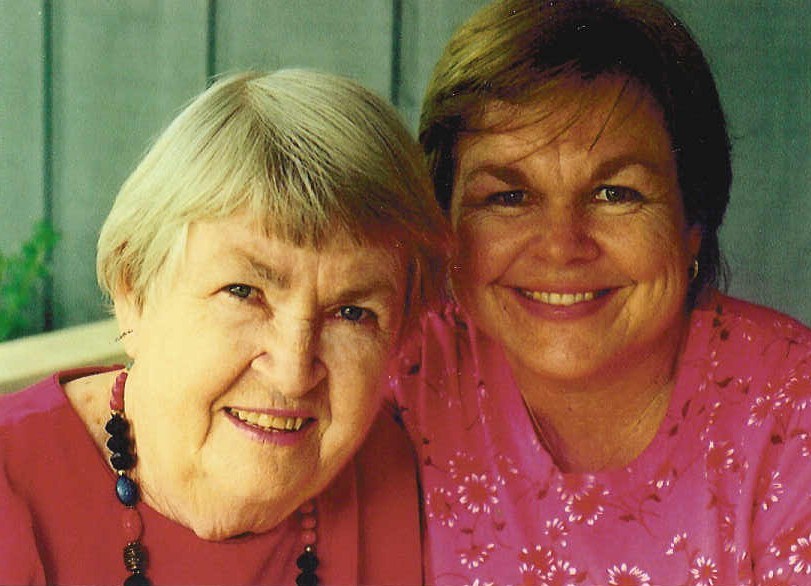
[Today is Mom’s birthday – 20 of them now in Heaven. This blog adapted from the Archives. ]
Our little family has never lived close to the grandparents. This was not easy…for any of us. Before I married, I lived close to home, and Mom was my best friend. She died 20 years ago, and I still miss her every day. To people who knew her well, I would often say “when I grow up, I want to be just like her.” Still working on that.
Mom and I shared a weakness for words…they are probably excessively important to us, delivering both positive and (sometimes) negative weight. She was an amazing encourager. She rarely missed an opportunity to lift another’s spirit or to speak loving truth to someone desperate for God’s touch.
When I moved away to take a teaching job, she and my dad helped me with the move. New Haven, Connecticut would be a 2-day drive from Georgia. At that time, it was the farthest I had ever lived from home. She stayed a week to help me settle in. While there, she was such great company. We explored the city together and laughed over a new culture and cried at the missing that was ahead for us.
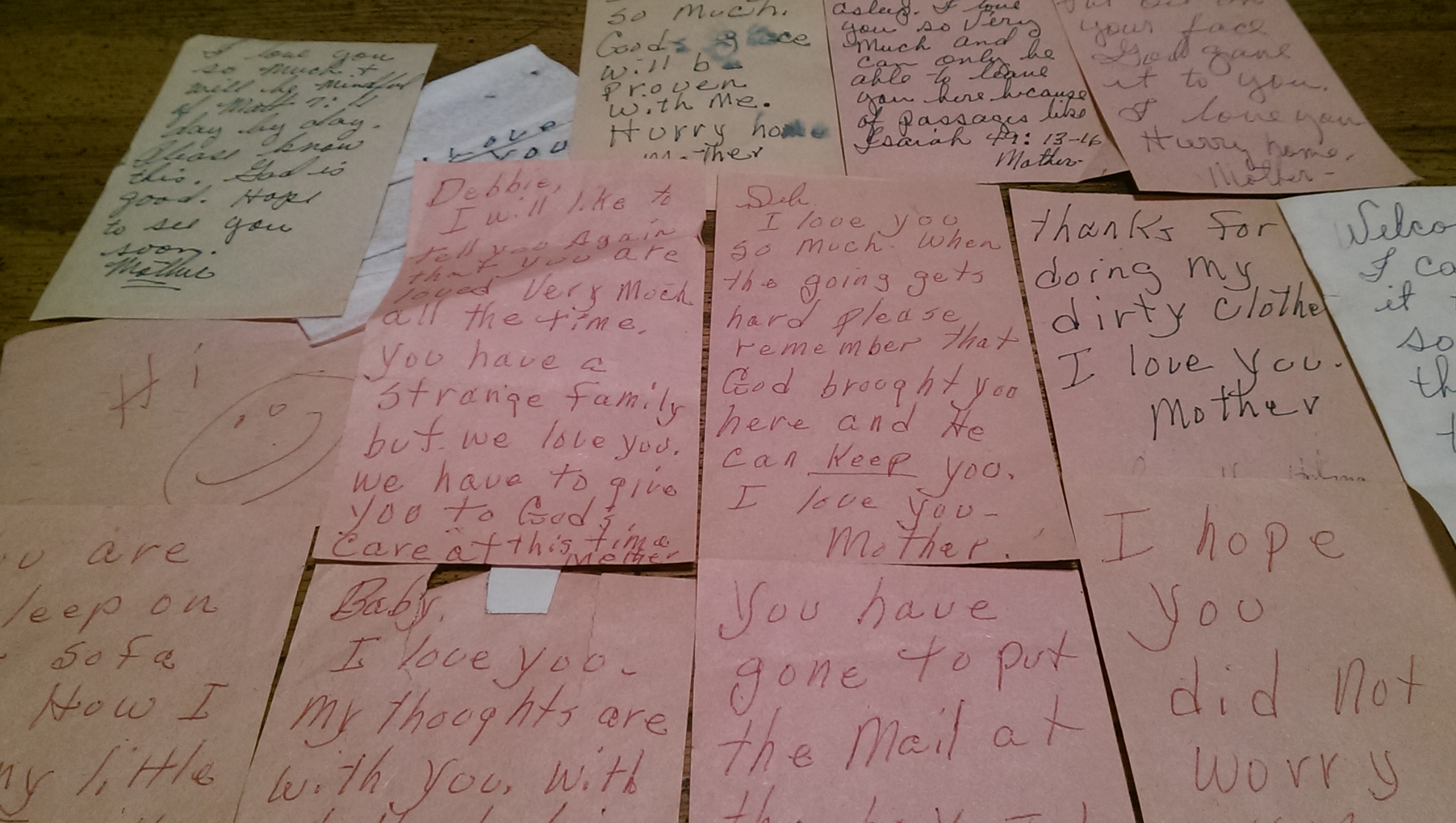
She filled my freezer with her baking, and, while I was at work, she wrote notes. Then she hid them everywhere. After she flew home, I began finding them. In my coffee mug. Under my pillow. In the pocket of my coat. Among my reference books. Behind my music books on the piano. She was with me in the love notes she left, and it made the distance between us…less.
My mom and I also had a weakness for bits of paper. I have kept every one of her notes. These from that move over 30 years ago are fading…red ink on pink paper. There is a lifetime of notes between Mom and me. The tradition she started on that first move has become a life-long tradition for our family. Our visits back and forth, across the US and then the globe, have been papered by these little notes.
Our children, from the time they could write, entered into this tradition much to the joy of their grandparents. Before we would leave from visits with them, these three young ones would write of their affection for their grandparents and hide them all over their houses. I delighted in their cooperation in this conspiracy of love.
Mom always wrote notes…not just to us but to so many. She and her Sunday School Class ladies would send cards every week to the sick ones or the sad ones. She had a special burden for the elderly, for widows (including functional widows, deserted by husbands) and for fatherless children (again including those “orphaned” by still-living fathers). She inspired me by her humble ambition .
Pure and undefiled religion before our God and Father is this: to look after orphans and widows in their distress and to keep oneself unstained by the world. – James 1:27
I am so thankful for my mom’s bits of paper…for her love…and for her perseverance in encouraging and serving others. Her generation is sadly almost gone, and it is for us to pick up these traditions, or traditions like them. Passing them on somehow to the next generations…Maybe there won’t be bits of paper or love notes like in the past. I do hope we still take the time to write. Definitely, the call to serve and to encourage is as current as ever. My life continues to be rich with those, young and old, who reach out with words of kindness and encouragement. Written or spoken, they are love notes to the heart.
Thanks, Mom. After twenty years, many may have forgotten you for now. Many more won’t know of you this side of Heaven. Your life may have seemed small, but it was larger than life to me. Thank God for you.
Therefore encourage one another and build up one another, just as you also are doing. – 1 Thessalonians 5:11
What does the mommy say to the little one, screaming, angry tears, head flung back, and arms swinging?
“Use your words.”
Great counsel for all ages.
Words are not always easy to come by. In fact, they can become all jumbled in response to the large emotions that demand an answer. This is the right brain/left brain challenge. Our emotions come just ahead of our determination of what they mean…and our “putting into words” that meaning.
As adults, we have also used silence in place of words, either intentionally to punish or unintentionally because we just did not know what to say.
Using our words is a healthy habit in relationships because it forces us to think through our emotions and process how they apply to any action we take in dealing with them. For example, someone significant to me says I hurt them or didn’t value their effort. I can respond in so many ways. Yet, what if I decided to “take the criticism” as a gift (this is graduate level relationship stuff) and use it to enhance my understanding of that significant other? What if I determined then to hear their pain or disappointment as true? It was definitely true for them.
Is it possible for me to humble myself and first respond to their hurt? Maybe seeking more clarification as to just what happened? Even if it means I sort out my part in that breach between us, confess my part, and offer an apology. Possibly even some sort of restitution. Would that open a path forward? It may very well be that we didn’t intend to hurt but a sincere acknowledgement of their pain (even an apology) is exactly what is needed for the moment.
Whew! A lot to process. If you’re still with me…
Use your words. What matters more than being right? Being in relationship…in community.
““Saint Augustine once counseled that the top three virtues of Christianity are ‘Humility, humility, and humility.’ One suspects he said this because when humility is intact, all other fruit of the Spirit fall into place. What Gavin Ortlund has given us in this wonderful book is not only a description of humility but also a pathway that makes the reader desire more of it, for the smaller we become in our own eyes, the bigger Christ becomes to us. I can’t recommend this book highly enough.” – Scott Sauls
Below are 10 practices that Dr. Ortlund presents as means to both grow and express humility in our relationships. In his book, you’ll find commentary on how to work these out in our lives – helping us to use our words well]:
These 10 practices are far from a trite handling of relationship woes. This is the foundation of using our words well.
Words can injure or heal. We all know this. If we want some sort of vindication or revenge, maybe using our words needs schooling. Silence isn’t the answer…it can last far too long. Too long.
If we truly want to restore a relationship or mend a fence with another, taking steps toward that person with true humility and a sincere desire to understand is where we start.
Coming to terms with our own story helps us use our words for healing. Perspective can lessen the sting from painful encounters. When we do the work of sorting out our own emotions related to conflict, then we can hear the other without triggering our own emotions from the past.
In Tyler Staton‘s book, Praying Like Monks, Living Like Fools, he talks about the role of confession in relationship building and rebuilding. Taking responsibility for our part in the conflict, saying it out loud, and asking forgiveness. When we keep silent or we don’t use our words in positive ways, we hide ourselves from the very exposure and vulnerability that confession frees us from. Again, this requires enormous humility…or, at the very least, a willingness to humble ourselves.
Confession is “to excavate down into the layers of your own life, uncovering not just what’s obvious on the surface but the layers of personal history underneath that continue to inform your present.” – Tyler Staton, Praying Like Monks, Living Like Fools
None of this is for the frail of heart…we can keep hiding behind pride, entitlement, hurt, and offense. Our various screens (social media, computers, phones, TVs) have taken our voice. We have, too often, become spectators of relationships, rather than deep in the beauty of being known by and truly knowing the people across the room from us.
Put your phone down, and use your words. Or…pick up that phone, and make the call…begin the process of reconnecting…which could lead to healing.
[Pet peeves are not anything we want to cultivate or nurture…I get to a more positive place at the end so hang in there with me.]
US culture has changed – especially related to encounters with strangers or those we consider insignificant or irrelevant – as shown by turned down or away faces, looking beyond people, or not engaging with those we don’t know or don’t care to know.
People passing in hallways as if a living human being isn’t within their visual field. Charting a course from Point A to Point B, maneuvering around people without words. Stepping aside, disengaging, when someone else enters the space and greets one of the two in conversation. Disinterested.
I don’t understand this lack of desire in connection. This avoidance of engagement.
Where does it start? I occasionally teach elementary school-aged children, and even at this early age, there are kiddos who seem to easily engage across groups and with authority figures, others who are shy to engage or are awkward in social interactions, and, finally, those who only engage with their buddies (unless pressed to engage with others). Is it a personality thing? A social anxiety? Is there an environment (classroom or home) that sets a pattern for the children who see and engage with those around them and the ones who refuse to see beyond their friend group? It’s probably complicated, right?
We have grandchildren that look, gaze, see others…and refuse not to be seen. I hope it never changes as they grow older. How did they get where they are as children? I need to ask this question of their parents.
Eye contact as a behavior of connection can occur on a spectrum. No one wants the gift of creepy, penetrating stare-downs. A more subtle or passing gaze could communicate a desire for engagement but accompanied by a further desire not to intrude. Or at the opposing end of the spectrum, the total lack of eye contact as if there is no one there…or the hope, with social anxiety, that if I don’t look, you don’t see me. However, somewhere in the middle of all this, is the one who makes steady and engaging eye contact. That one that says with their eyes and facial expressions, “I see you”. Conversation may or may not follow…but to be seen and acknowledged is a small and precious gift we can present to another.
A life habit easily developed is to determine to see those around us. To make meaningful eye contact. To honor those in front of us (whether a store clerk, fellow employee, or guy in the gym). Lock eyes, a head nod, a smile, a greeting – communicating “I see you”.
This comes to play in all sorts of situations. It is a humanizing practice. A situational awareness that goes beyond keeping ourselves and others safe. It communicates that we matter in the spaces we share.
In our city, as one for instance, we see people with signs at many of the intersections. Beggars. Homeless. Not really sure. The very least we can give them is our eyes…acknowledging them whether we give money or not.
Remember, I spoke earlier of a pet peeve not being something I want to indulge, right? So…
A pet peeve is a button pushed. Long ago, I made it an aim to get rid of the buttons in my life. They divide us and there’s enough division out there already.
This is one I’m still wrestling with…and not to my credit. It becomes easy for me to intentionally ignore, or see past those who see past me…or those who “refuse to see” ones who matter to me. Yet…am I not doing the same thing then? By faulting those in my small opinion are “refusing to see”? When we fault people, without understanding them, we don’t really see them either.
Friday Faves – coming in hot! Days later. Life races on, doesn’t it?!
1) Beyond the Guitar – Magic on a Cheap Guitar – Sweet original composition by classical guitarist Nathan Mills at Beyond the Guitar. Showcasing two very different guitars…or rather what the difference – pretty much, it’s the guitarist, not the guitar. [Not to say the beautiful David J. Pace guitar isn’t his go-to instrument for all his guitar work/performances…but to emphasize it is the one playing it, whatever the guitar is, that makes the music.]Photo Credit: Beyond the Guitar
2) The Most Repeated Command in the Bible – Even more than “Love the Lord your God” or “Love your neighbor as yourself. The most repeated command is “Do not be afraid”.
Something to think about because we are surrounded to fearsome situations…yet, we are not to fear. How do we keep from it?
By practicing remembering. Remembering the provision of God in times past. Remembering the goodness of God in all we have in life right now – people who love us, work and other resources, health and/or helps toward restoring health, time, meaning, forgiveness, and beauty surrounding us.
The tricky thing about fear is that we can’t necessarily stop it from happening. It comes over us. However, we can keep it from overwhelming us…determining to live in the freedom and light of what is true, instead of what could happen. God is there for that as well.
When fear messes with our relationships or makes us timid to enter new ones, we can take courage in the command “Do not be afraid”. This week in our church, in The Art of Neighboring, we studied about fear in neighboring relationships. 1 Peter 3:14 (quoting from Isaiah 8:12) Do we allow fear of rejection or fear of our differences keep us from leaning into each other? What if we leave fear out of the equation in caring for one another? That’s the better path.
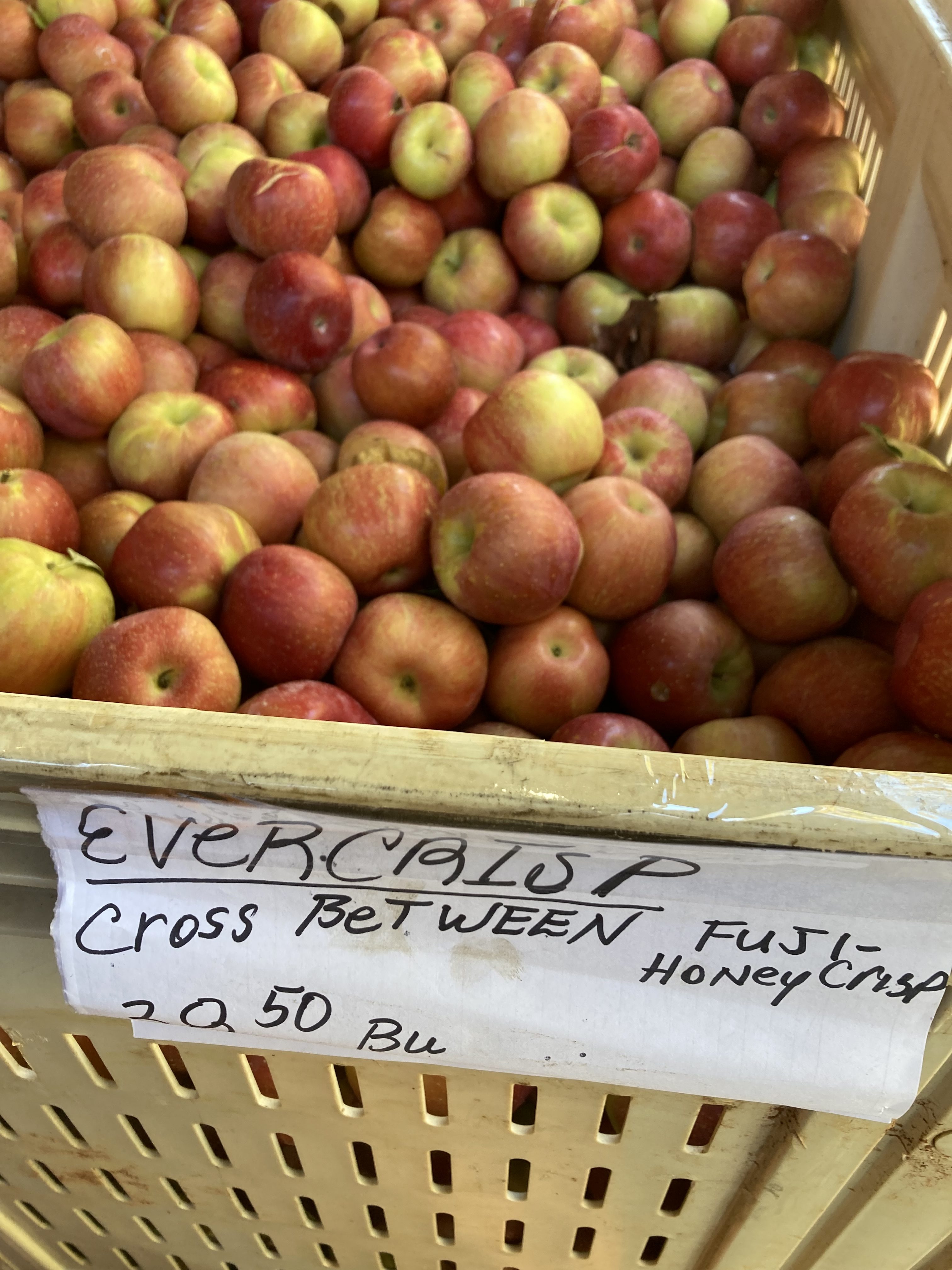
3) The Evercrisp Apple – One of the best parts of this time of year is the Fall apple harvest. Honeycrisp, Pink Lady, and Cosmic Crisp apples have been our favorite in recent years…until this Fall, when we discovered the Evercrisp apple. Wow!
We discovered this apple on a recent trip across Virginia toward the Appalachian Mountains. The Apple Shed delivers on several types of apples and introduced us to this one.
Once back in Richmond, we were thrilled to find it sold locally from the Saunders Brothers Orchards. Woohoo!!
A small delight in life but, for this season, a huge one. What’s your favorite apple?
4) (Dis)Comfort Zone – Is the phrase “comfort zone” a first world experience? I don’t think so. It is a universal idea – a place where we feel safe and soothed. A bad thing? Not necessarily except for how it insulates us from the rest of life. What if developing our capacity for discomfort helps us to live more fully, more in community?
Jason Seib, a health and selfcare coach, has actually built his whole platform on embracing a (dis)comfort zone. He teaches how we can maneuver around our uncomfortable moments in healthy ways.
If you go to his website, his home page currently seems all about his workshop (which I haven’t taken although it is reasonable cost-wise). However, hang in there. He also extends solid content to non-subscribers through his podcasts and social media pages. I think that speaks to his integrity as someone who actually cares about people wherever we are in our comfort zones.
The main message for us in his coaching is that we reach for food, alcohol, or other addictive substances or activities when faced with discomfort. Our temptation is to do whatever we can to restore comfort. Jason Seib points to developing skills in sharpening our awareness of discomfort when it happens and respond in ways that don’t harm us.
Jason Seib reminds me of counselor Brad Hambrick whose webinar on “Growing in Negative Emotion Tolerance” was extremely helpful for me. Seib and Hambrick both talk about the importance of us recognizing that negative emotions are not necessarily bad [they are actually informative] but how we respond to them matters.
5) Old Friends – This week has been one of celebrating old friends – visits both here and states away with people who have stayed the course with me through years and years.
I don’t know about you, but loneliness is a real time experience for me. So many moves and changes for us. A different season – children grown with their own lives, me now in retirement sorta kinda, and most of my closest friends living far from where we now live.
It gives pause to reflect on friendship and revisiting the kind of friend I am and hope to be. A key to having old friends in our every day life is continuing to reach out and nurture those relationships. I’m working on it…and trying to show up for these friends who have shown up for me. They, and others like them, point the way.
Old friends, even while not on the daily or even the regular, have the rare quality of history. Memory. Understanding. Loving anyway, through seasons of neglect, distraction, and loss. Old friends remain.
So grateful for forever friends – people who know us well and love us anyway. Singer, songwriter Michael W. Smith‘s song says it all:
“Come deeper. The waves won’t knock you down back here!”
Deeper in the Word
Deeper in Prayer
Deeper in Worship
Deeper in love with Jesus
Yes, the waves will still come, regular and strong.
But in the deep…
We will have peace,
We will be comforted,
We will have healing,
We will have restoration,
We will have joy,
Because we will be moving with The One who controls the winds and waves.
Just last night I was confronted again with one of the tolls of the COVID epidemic. That toll being a physical isolation that has grown into a lingering social isolation. A friend texted me about her sense of feeling disconnected, even unseen, in the midst of her church community, of all places. She is reaching out but has not yet found her people. I tried to encourage her to keep reaching out and she would eventually find those friends, that connection for which she is longing. This isolation, this loneliness, is something I, too, was fighting against and occasionally successful.
She told me this had to be my next blog (title) and so it is…although I don’t have answers…but will share what I’m learning from my own journey and from wise others.
“Here’s what we do: We spend hours alone in our crowded, noisy, screen-lit worlds, we invest only sporadic time with acquaintances, and then we expect close friends to somehow appear in our busy lives.” – Jennie Allen, author of Find Your People: Building Deep Community in a Lonely World
Being retired from my usual work has afforded me much discretionary time…time which can be lavished on others or on disciplines like study, prayer, and writing. Too often…this time on my hands has taken me to places too quiet…where I get lost in my thoughts. That is an excellent description of this loneliness that comes from isolation.
We think too much maybe. Get lost in those thoughts and become slow to respond. Instead of going after friends, we wonder where those friends are…is it us? Is it them? We look for reasons for the unsought solitude we find ourselves in yet we can’t seem to fight off the sluggishness of too-long isolation. We text instead of call. We do electronic meetings instead of face-to-face ones. We cling to smaller rhythms instead of restoring larger lives.
OK…is that just my issue? I don’t think so. The phrase “new normal”, no longer in vogue, is a misnomer. It deludes us into a posture of waiting…rather than seizing on what’s right in front of us. Whatever is the present normal…that is what we have. This present normal.
This present that we have is fleeting, temporary…but the people around us are not. Yet, relationships require some level of intentionality. A wise counselor once told us, during a season of multiple moves for work, to “put down your roots as deeply as you can – wherever you are”. COVID mediation has pushed us toward shallow relationships. We don’t want to miss people in the dullness of this odd season.
My beautiful friend above is already on the way to an answer to her loneliness because she is recognizing the “what’s not right” about her current situation and she’s not holding on to the status quo. That is forward motion right there. I am hopeful for her and for myself.
“Friendships change.” Following you will find Kampakis’ 10 thoughts (abbreviated from her blog) on the struggle – written for middle school girls but applicable to any of us. Especially as we face loneliness and isolation and want to either jump-start or strengthen our friendships:
1. It’s normal for friendships to evolve and change.
2. Everything will be okay. – Be patient, pray for good friends, and pray to be a good friend.
3. Rather than focus on finding the right friends, concentrate on being the right friend. – When you treat people well, you’ll attract friends who treat you well too. By holding yourself to high standards, becoming the friend you wish to find, and choosing to be an encourager rather than a critic, you set yourself up for positive and long-lasting relationships.
4. Even when you find your “people”, always leave room at the table to invite someone new in. – Kampakis lamented: “One regret I have from high school and college is not reaching out more beyond my circle and letting God open the door to unexpected blessings.”
5. Love your friends well, but keep a loose grip. Give them space to explore new friendships and explore new friendships yourself.
6.Remember that everyone is learning and gradually maturing. Just because you don’t click with someone now doesn’t mean you won’t click later.
7. The biggest friendship killers are jealousy, comparison, insecurity, and fear – fear of rejection, fear of being left out, and fear of being alone. Acting on these emotions can turn you into someone you’re not. – By being aware of your negative emotions yet learning the self-control to not act on them.
8. Form your own opinions about people, and don’t believe everything you hear. – Treat everyone like a friend until they give you a good reason not to, and when possible, give people the benefit of the doubt.
9. Know the difference between committed friends and casual friends. – Committed friends are the kind you carry through life. They have your back and will stand in your corner even if they’re your last friends standing. Casual friends are the kind you have for a season of life, maybe a few seasons.
10. Be kind, and keep in mind that kindness is more important than popularity.
Those 10 points were written for middle schoolers. It was a great reminder to me of the sweet simplicity of pursuing friendship. Both in rekindling neglected relationships and sparking new ones.
The world won’t all of a sudden become warm and welcoming…but I am ready to stretch again. It feels almost like a hungry bear coming out of a long hibernation. It’s possible to shake off the sleep of shallow relationships. To be more present with people – not just on my terms but open to enter into their space…both heart and head.
Life does not stand still for us. I have friends and family that are dear to me and yet we rarely see each other. Do we think that is going to happen somewhere down the road? Magically? There’s a place for urgency in dealing with the habitual loneliness we have come to know in recent months. My friend above is taking steps as am I. Cautiously, awkwardly…but occasionally successfully.
How about you? What’s your story? [Comment below.]
[Sidebar: If you’ve read this whole piece and wondered what’s the issue because you have great friendships – current and satisfying – maybe see Kampakis’ #4 again. “Leave room at the table for someone new.” Don’t circle the wagons. If you are basking in the experience of an inner circle, turn around – someone who may need you, or you them, may be just outside. Invite her in.. New friendships can be costly but the benefits are worth the expense and the risk. *]
Daily our prayers are full of questions. We “inquire (ask from) the Lord”. The questions in our heads don’t always end up in our prayers, but they are there nonetheless.
He wants us to wonder about Him, about life, about people…with Him. He also means for us to use His own explorations as a model for our interactions – our deep interactions – with each other.
Christian psychiatrist Curt Thompson writes about four questions the Lord asks (in his book The Soul of Desire). These questions, when we ask them of each other, within context of relationship, can forge a path. A path for that other person to experience being “seen, soothed, safe, and secure” with us.
1) “Where are you?” – God asked Adam this question (in Genesis 3:9), not because He didn’t know where he was but to give him an opportunity to say for himself what had happened. After Adam and Eve had sinned, they hid from God. In fear and shame. They had succumbed to distorted thinking after being tempted by the Evil One. They doubted the goodness of God and made the eternally consequential decision to choose for themselves what was good.
We also hide. We might not ask of another “Where are you?” exactly, but we might ask, “What’s going on?”, “What’s on your mind?” or “What are you feeling right now?” Rather than react to another’s anger, fear, or other distress, we lean in. Just as God was drawing out Adam, we give space for a person to feel safe to come out of hiding. We give space to ourselves in the same way when we go deep with God around this question.
2) “What do you want?” – In the beginning of Jesus’ public ministry, two of John the Baptist’s disciples began following him. His first question to them was “What do you want?” (John 1:38) We don’t often ask God what He wants with us because the Scripture is clear. Yet, we struggle with what we want. Are our desires in line with the Lord’s? Do we ever edit or stifle our desires because we can’t fathom they are in line with the will of God? What if they are? Or some form of them? This is where we inquire of the Lord. This is also where we can be helpful to each other by giving opportunity to wrap words around those desires. To bring them out in the open in a safe environment with a trusted friend/family member. This, like Question 1, is something we also can explore with and seek affirmation from our Heavenly Father.
3) “Can you drink the cup?” – In Matthew 20:22, Jesus responded to a voiced desire of James and John to sit on each side of him in His kingdom. His question communicated that their desire implied a cost – a cup of suffering. They naively said they could drink the cup. His gentle reply was that they would drink that cup but the decision was not his but the Father’s. What beauty in the freedom of transparency and intimacy Jesus and his disciples had with each other.
“If we want to be this close to Jesus – if we are willing to enter into a confessional community and ask the first two questions – we must be prepared to suffer. Naming where we are and what we want invariably leads to discoveries that bring us great comfort but also demand that we be present to the brokenness of our own lives and that of others.” – Curt Thompson, The Soul of Desire, p. 201
Part of the benefit of exploring the two first questions with a trusted someone is that we come to question 3. No longer is the stuff in our minds and emotions still hidden, but it’s out there. In the real world. This is when we can confront the cost…and this is where we find both healing and flourishing.Photo Credit: Heartlight
This is where we can have hope. Where our fear and shame can be removed. Where our addictions can be faced. Where our delights in the Lord can be fortified…within community.
“Evil does not intend to go quietly into the night. In this way, we will suffer; we will drink the cup that represents our resistance to evil as we swim against its current… In the context of a confessional community, we suffer, we grieve together, and as such our suffering itself is transformed…I learn to hope. I hope not in receiving exactly what I thought I wanted in the way I wanted it, but more.” – Curt Thompson, The Soul of Desire, p. 205
4) “Do you love me?” – After his resurrection, Jesus appeared several times to his disciples before ascending to Heaven. This question he put to Peter. Now Peter was probably still reeling with shame from his denial of Jesus. He felt disqualified. Purposeless. Such that he returned to the trade he did before ever knowing Jesus. Jesus’ question “Do you love me?” clearly had multiple layers. He understood the rupture that happened when Peter acted the way he did. It wasn’t ruptured from Jesus’ side but was, in Peter’s head, from his side. Jesus drew close to Peter to fix that rupture and to remind him of the great work he had called Peter. “Feed my sheep”.
“Jesus takes the essence of our traumas and its attendant shame and creates New Wine. There is beauty to be found everywhere. But never is beauty more poignant than when we see it through our trauma and shame. We see Good Friday through the lens of Easter and everything about its brutality, its pulverization of God in the person of Jesus, is transformed into the beauty of the resurrection. This is what it means to fully answer the question, “Do you love me?” – Curt Thompson, The Soul of Desire, p. 210
Worship, with me, the God who seeks after us and draws us close – the God who will create beauty in and through our lives as we live in the real, with Him within. [Psalm 27 – Motion Worship]
One thing I ask, one thing I seek
To live in Your house, to sit at Your feet
All of my days, delight in Your ways
And dwell in Your temple
So hide me in shelter when troubles may come
My feet set on high ground, my head lifted up
When darkness surrounds, in You I am found
And there’s joy in this temple
[Chorus]
I will sing, I will praise
With all that’s within me
I will seek, seek Your face
Jesus, my one thing
Oh Jesus, my one thing
(Yeah, yeah)
My heart believes, our eyes will see
The goodness of God in the land wе’re living
So we will be strong, and Hе won’t be long
And we’ll wait on You, Lord, yeah
[Chorus]
And I will sing, I will praise
With all that’s within me
I will seek, seek Your face
Jesus, my one thing, yeah
And I will sing, I will praise
With all that’s within me
And I will seek, seek Your face
Oh Jesus, my one thing
And oh Jesus, my one thing, yeah
Oh Jesus, my one thing (Oh, yes, You are, You are)
Oh Jesus, my one thing (Yes, You are, yes, You are)
Oh Jesus, my one thing, yeah
[Bridge]
And there’s joy in this temple, there’s praise in this house
With light and salvation, no fear can be found
When enemies rise up, they tremble and fall
None stand against Jesus, the name above all
There’s joy in this temple, there’s praise in this house
With light and salvation, no fear can be found
When enemies rise up, they tremble and fall
None stand against Jesus, the name above all
[Chorus]
And I will sing, I will praise
With all that’s within me
I will seek, seek Your face
Oh Jesus, my one thing
Oh Jesus, my one thing (You are)
Oh Jesus, our one thing
Yes, You are our one thing (Jesus, my one thing)*
“Be curious, not judgmental”. This brilliant and pithy statement is attributed to the American poet Walt Whitman. I’d never heard it before today, and yet it speaks volumes to any human relationship – whether personal or professional.
There comes a time in knowing people that we think we have them figured out. Or we know enough…for better or worse. We stop asking questions. Whether in marriage or in the workplace. We think we know all we need to know about a person… ironically, just when we are feeling the less fond of them. When conflict bubbles up. When a critical decision is being made. When a door closes in our face…or on our way out.
This is humorously and poignantly illustrated in a scene from the TV show Ted Lasso. [Full disclosure: I have never seen the show itself. Also my understanding is the language is fairly unfiltered, so this isn’t exactly a recommendation…but this scene is perfect.]
“Questions are the main ingredient in curiosity. And curiosity is itself an important component of the communication patterns that generate psychological safety, quality in interpersonal relations, and collective intelligence. In other words: all the different elements that impact on the quality of our collaboration, decisions, and actions, and which ultimately become a determining factor for the results and value we create for our customers and the wider world.
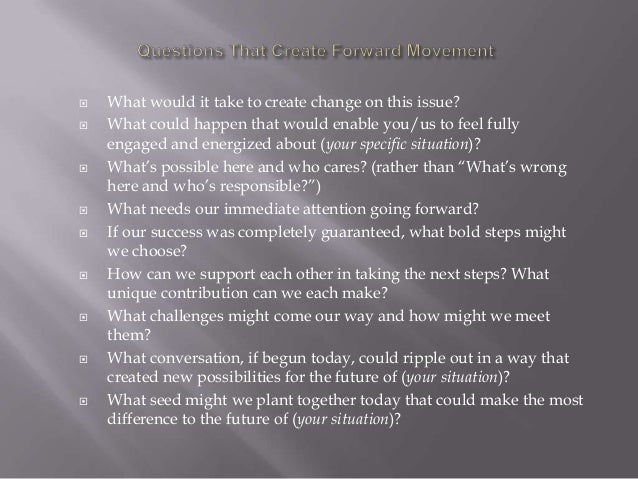
We can ask questions in many different ways, and all are not equally constructive. For example, there is a great difference between a leader asking his employees: Why didn’t you do something about the problem? and asking: What do you see as possible solutions to the problem we are facing? The first question reflects the leader’s view that the employees ought to have responded and taken responsibility earlier. It creates a focus on blame. The second question expresses the view that there is a problem that everyone involved needs to address and come to a solution together. It invites employees to commit and involve themselves in finding solutions in a forward-looking movement. Being aware of our way of asking questions has a big impact on the way we relate to each other – and also on our ability to contribute, do, and achieve things together. As such, good questions can’t really be put in a template. The quality and effect of the questions always depend on the context they are asked in.” – Henry Kleive, Thomas Johansen and Thomas Specht, “Leadership for Sustainability Powered by Questions”
What if we went into conversations or meetings with an open mind and questions aimed at honoring and understanding the person across the table? What if we wanted to reconcile our relationship as much as we wanted to prove ourselves right about the project, or problem, or predicament?
Learning to ask powerful questions and being willing to use them can make a huge difference in our relationships. Asking questions well can demonstrate care for that person. Sometimes questions actually help both the one who asks and the one who answers with what they really think about a situation…questions draw us out…often in positive and fruitful ways.
So whether or not we think we’re right about a person – their motives, intentions, abilities, or intellect – we won’t do justice to the relationship if we stop asking questions.
Get to know him or her again…use the questions offered in the resources above and below. Find common ground, through good questions. See if you can turn the (relation)ship around…not just for the sake of the team, organization, or family…but because of the benefit to each of you.
“Lead From Within: A leader is as good as their questions. When you ask questions, you will change what you know. When you change what you know, you will have a new understanding. When you have a new understanding, you change your actions—and, ultimately, your leadership.” – Lolly Daskal
[From the Archives – I wrote before on Emotional Intelligence here, here, and here. Below you’ll find the summaries from those pieces.]
You can probably remember an encounter with someone who was so engaging and interesting that you hoped you would meet them again, or work with them some more, or even become their friend.
Below is a story of how I experienced emotional intelligence in a beautiful and transforming way.
Years ago, I worked for a beloved organization. In that work context, I’d had an idea of a particular needed next step. Even though it wasn’t a strength of mine to carry the ball on it, I saw such a need for it to happen that I floated it a couple of times to our leads.
It didn’t go anywhere…timing, not the right people in place…lots of variables.
Then, out of the blue, an announcement came down that we were going to run a pilot on that very idea. The woman leading the pilot was perfect for it. Enthusiastic, funny, bright, humble, and inclusive. Perfect.
I messaged her about how excited I was about the pilot and told her if I could be any help at all, just let me know.
Because of who she was (and maybe the timing…although I think it was just her), the project hummed along. Lots of others jumped in to help. I was so excited. Felt no need to push in but wanted to cheer-lead any way possible.
Then she wrote me this brief message – surprising and lovely – full of emotional intelligence. She said at that time she didn’t need more folks on the project, BUT she commended me and expressed her gratitude for my support. Just a message. A few lines.
It was just what I needed and I didn’t even know I needed it.
“Emotional intelligence (EI) is the ability to monitor one’s own and other people’s emotions, to discriminate between different emotions and label them appropriately, and to use emotional information to guide thinking and behavior.”
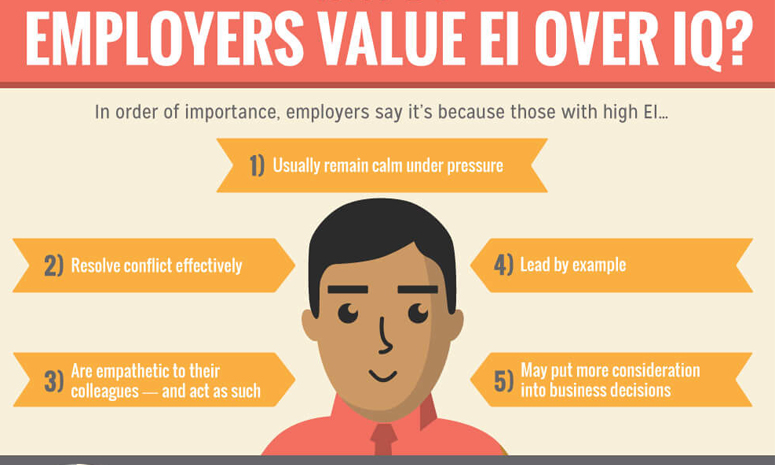
Remember this distinction: there are smart people and then there are emotionally intelligent people. If you don’t have a sense of the difference in these two, Paul Sohn posted an infographic (yay!) that gives an excellent description of emotional intelligence. There are a lot of smart people out there but what a joy when your boss, as smart as he may be, is also a great communicator with and appreciator of people. [Go back and click on that infographic – very helpful!]
Two of Monge’s points were: 1)Leaders with low emotional intelligence say “I’m sorry you feel that way” more than “I’m sorry,” and 2) Leaders with low emotional intelligence often blame the people they hurt for the situations leading to them being hurt.
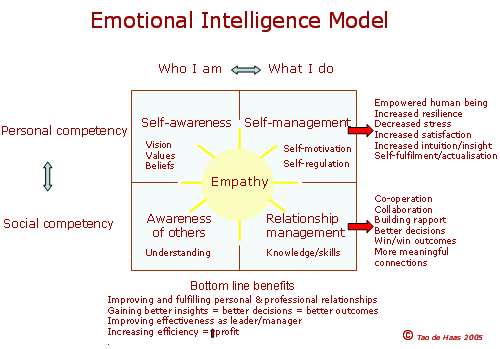
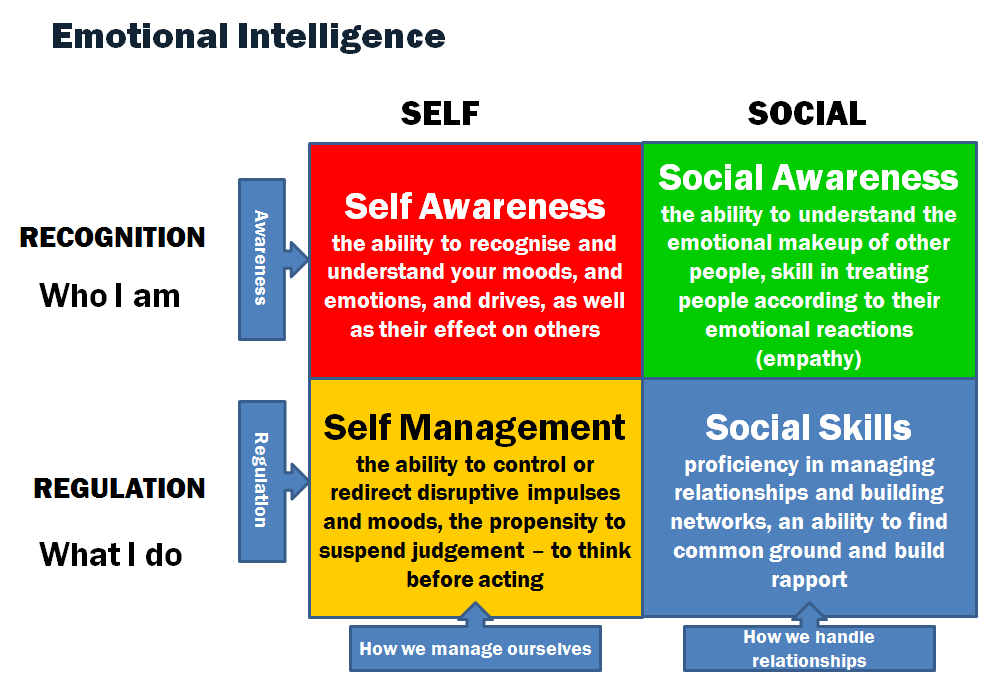
Daniel Goleman has written several books on this topic including Emotional Intelligence: Why It Can Matter More Than Intelligence and Social Intelligence: The New Science of Human Relationships. The very cool thing about emotional intelligence is that it can be developed. The big dilemma is whether bosses or even teammates, not bothered by their impact on others, would buy into this relational skillset. Incorporating such concepts in personnel accountability metrics might provide some incentive. I’ve added graphics below that helped me further understand emotional intelligence.
Schwantes encourages us to respond rather than react in a conflict situation. His seven action points follow (read more of his article for his commentary on each one).
Get perspective.
Take a 6-second pause.
Stay humble.
Try empathy.
Ask the most conflict-diffusing question. [“Are you ok?” What’s going on?”….what else would you think would diffuse the situation?]
Speak from your authentic self.
Be the first to reach out after conflict.
Don’t miss the brief video at the end of Schwantes’ piece on 3 Simple Questions to Improve Your Emotional Intelligence.
I hope you’re surrounded by emotionally intelligent people. Maybe you’re an “EI” rockstar yourself. For me, that woman above, piloting the project, had my respect from the beginning, but because she responded to me in such an honoring, genuinely considerate way, she also has my complete support and more.
Do you have any emotional intelligence stories? Please comment below. We can always use stories of great bosses and coworkers to inspire and spur us on.
OK…who hasn’t heard this encouragement? “You’re stronger than you think.” I have never cared for it. Why? Because it pushes the weary soul, doing all we can to stay afloat already, to “just keep swimming”.
Not that any of us wants to quit whatever we’re about…but…is there a truer truth?
The “stronger than you think” quote has been attributed to A. A. Milne, author of the Winnie-the-Pooh stories. Written by and published in the 1920s. This was a time post-World War I and prior to The Great Depression and World War II. The expression of “pull yourself up by your boot straps”and the mentality of self-reliance was fueled in those days, in literature and culture. It continues today.
[Now, you should know Milne did NOT write that expression. A writer at Disney must have. It is a quote from the animated film (1997) “Pooh’s Grand Adventure: the Search for Christopher Robin”. Pooh’s dear friend Christopher Robin is going away to boarding school and is trying to give Pooh, and himself, the courage for them to be apart. That message is there but not in so many words as in the Disney film.]
So…after that bubble burst, let’s return to the oft-quoted “stronger than you think” encouragement we find everywhere. It seems to speak to our culture…across generations.
Self-reliance. Work harder. Work smarter. We can do better. Sigh…
When we are told by a friend or family member, or even a social media stranger, that we’re stronger than we think, we are not being encouraged to lean on community…or God. We are given the message that somewhere inside ourselves, alone, without others, we can tap into more strength than we are feeling at the moment.
Is that really encouragement? I know we mean well…but do we really want to offer up Disney verbiage to a real struggle?
When I’ve gone about as far as I can go, can I slog out more, just with my own “main strength and awkwardness”? Maybe. At what cost and to what gain?
I got a phone call earlier today from a mom needing an understanding ear on a hard struggle involving her young son. She’s a terrific mom. Yet…she’d come to the end of her rope on this one. She sounded on Empty. Did it help that we talked? I think so…and definitely it helped to pray afterwards. She will find the way to help her son. She has a way forward even if she doesn’t see it clearly yet. Through her own resolve and experience. Through deep community. Through an enduring faith in a wise and loving God.
The Apostle Paul speaks so eloquently and practically on this issue of our weakness and God’s strength. In fact, when we come to the end of ourselves, we find God’s strength perfect in our weakness. It’s both a hard truth and great comfort. We don’t like the experience of coming to the end of ourselves. Nor do we like to see our friends and family moving so close to that reality. For this reason, we encourage those we love to dig deeper.
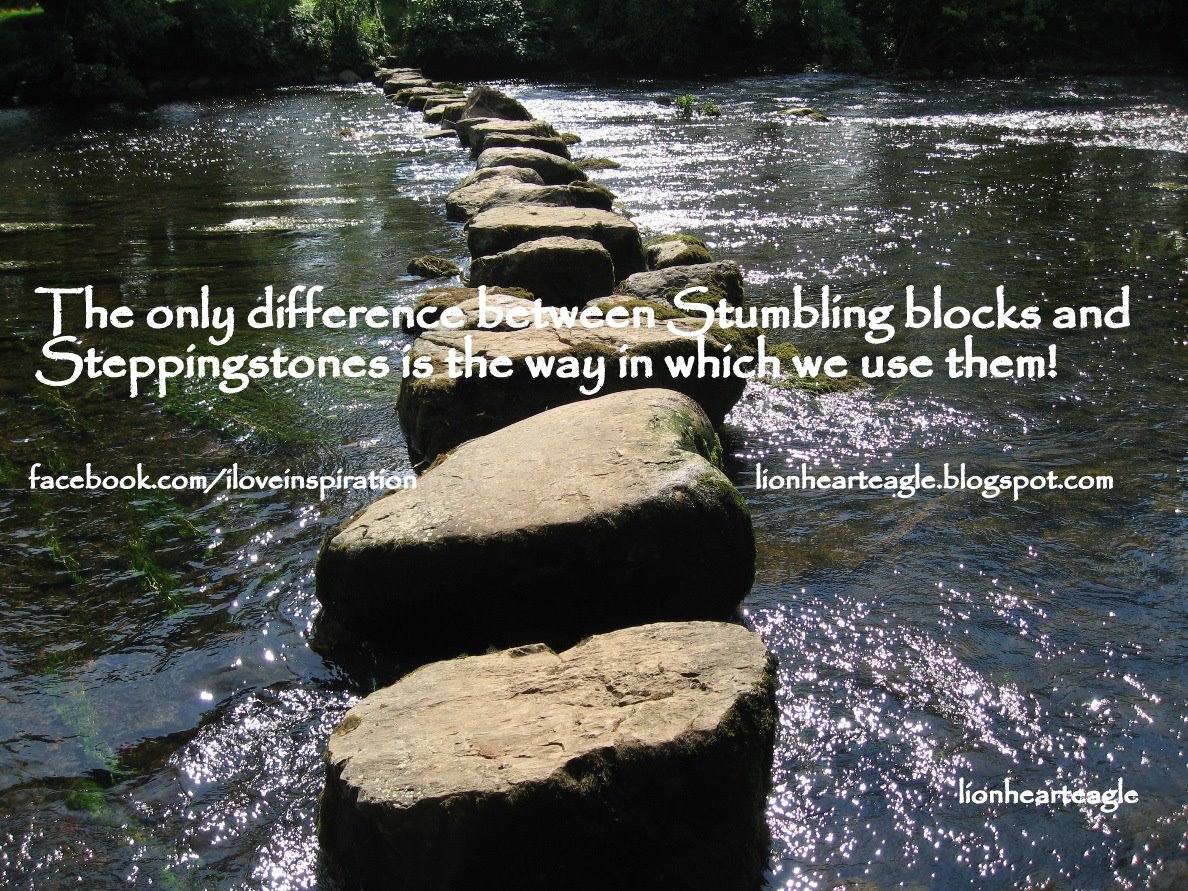
You know I love words…and I squeeze as much good out of them as I can. The Pooh video clip above and its messages of the richness of relationship do have meaning for us. Part of that meaning is how sustaining relationships can be even with we are apart from each other. However, the best part of relationships and how much stronger they make us comes from the moment-by-moment reach of them in the present. When we are there for each other (and pray for each other) we become stepping stones rather than stumbling blocks.
When we seek to encourage with words like “You’re stronger than you think”, your heart will be heard. Lean in with those words…and pray for that one in the struggle.
[Mandisa sings about how hard things make us stronger BUT she says that in the face of God being right there with us – holding us through whatever comes. We can rest in Him…and each other.]
1) Beyond the Guitar Nostalgia – How about all the feels from musical themes of favorite old movies? That’s what happens for us when Nathan arranges and performs themes from films we love.
While he takes a brief hiatus from his usual YouTube channel to focus on other work, only we Patreon subscribers get to hear the latest (subscribe). He is creating some new instructional content which makes me want to learn classical guitar. In this bit of time in the interim, I decided to highlight some of his arrangements already appreciated by 500k-plus YouTube subscribers. Enjoy. Oh, and comment below a favorite song of yours that he arranges/performs.
2) Parents & Adult Children – If we have grandchildren, then we have adult children. Loving them both in ways they understand is a crucial part of our life journey. This week I came across 3 excellent and empowering articles by author, counselor Dennis Rainey. If you want to parent adult children well, these articles have wise and applicable counsel for you. You adult children might enjoy them as well. The articles are linked below along with a couple of others that are also treasures.
Sometimes, we can be hard on our adult children. Too many demands or expectations. I’m sure I’m not alone with bringing my own vision into the present of what our family would look like, all grown-up with little ones. To be honest, they can also be hard on us (without even realizing it). However, what’s more important? The people in these relationships! Full-stop. Our kids have their own sharp learning curves of life without pressure from mom and dad to bend in our direction. It’s enough to see them when we can and cheer them on in their own new life configurations. If they make choices we would not make…it doesn’t change the love. Remember they also deal with the choices we make.
Read the articles. You’ll be glad you did.
“Life is a pilgrimage of learning, a voyage of discovery, in which our mistaken views are corrected, our distorted notions adjusted, our shallow opinions deepened and some of our vast ignorances diminished.” – John Stott
Alison Wright‘s The Death of the Family Gathering – We’re in a season when extended family gatherings are rare, happening over a funeral or wedding. My birth family never did reunions but they always looked so fun. We would, from time to time, gather at grandparents at the same time, but it was never planned. Wright’s article touched my heart. We work to make family dinners happen once a month and a family vacation each year. Worth the battle with busy schedules.
3) Welcome to Holland – This goes out to you who are parents, siblings, extended family or friends of children/adults with special needs or medical complexities. A friend introduced me this week to “Welcome to Holland”, a beautiful essay by Emily Perl Kingsley. My friend has a medically complex child, and so did I.
“Did” only because he is grown now. When he was little, he had major struggles and still has some of the aftermath of those struggles and always will.
When Dan came home to us through adoption, we knew he would have his challenges, but you’re never prepared for the twists and turns of that through childhood and into adulthood. With all the trips to doctors and therapists, meetings with teachers, and one-on-one times with him as the topic, there was still his joy that kept us marveling at this wonder.
He was an incredibly exuberant kid and seemed far less bothered by his struggles than we were.
A friend, years ago, asked us, regarding Dan, “What’s it like to have a ticker tape parade thrown for you, every time he sees you?”
I am often asked to describe the experience of raising a child with a disability – to try to help people who have not shared that unique experience to understand it, to imagine how it would feel. It’s like this……
When you’re going to have a baby, it’s like planning a fabulous vacation trip – to Italy. You buy a bunch of guide books and make your wonderful plans. The Coliseum. The Michelangelo David. The gondolas in Venice. You may learn some handy phrases in Italian. It’s all very exciting.
After months of eager anticipation, the day finally arrives. You pack your bags and off you go. Several hours later, the plane lands. The flight attendant comes in and says, “Welcome to Holland.”
“Holland?!?” you say. “What do you mean Holland?? I signed up for Italy! I’m supposed to be in Italy. All my life I’ve dreamed of going to Italy.”
But there’s been a change in the flight plan. They’ve landed in Holland and there you must stay.
The important thing is that they haven’t taken you to a horrible, disgusting, filthy place, full of pestilence, famine and disease. It’s just a different place.
So you must go out and buy new guide books. And you must learn a whole new language. And you will meet a whole new group of people you would never have met.
It’s just a different place. It’s slower-paced than Italy, less flashy than Italy. But after you’ve been there for a while and you catch your breath, you look around…. and you begin to notice that Holland has windmills….and Holland has tulips. Holland even has Rembrandts.
But everyone you know is busy coming and going from Italy… and they’re all bragging about what a wonderful time they had there. And for the rest of your life, you will say “Yes, that’s where I was supposed to go. That’s what I had planned.”
And the pain of that will never, ever, ever, ever go away… because the loss of that dream is a very very significant loss.
But… if you spend your life mourning the fact that you didn’t get to Italy, you may never be free to enjoy the very special, the very lovely things … about Holland.
4) Food Fit for Memory-Making – Writing for the last two weeks has been on the back burner. We’ve been traveling, seeing friends, and enjoying great food as part of those experiences. Now that we’re back home, eating to live more than living to eat will have to be restored to the daily.
However, can I just celebrate great food for a moment. The images below take us back, just the last two weeks, to food shared with friends in beautiful spaces. An anniversary was celebrated and Dave got his Butterfinger Blizzard – a twice-a-year indulgence which never disappoints.
My mom’s cooking has settled deep in my memories since she’s been in Heaven for 20 years now. Nothing like her biscuits and gravy, Thanksgiving dinners, and vegetable soup and cornbread. Sweet memories of her and the food she prepared. Memories imprinted by food shared together.
The memories we’ve made recently, accompanied by food, will suffice for now. Bonappétit .
Shyndigz – a local desserterie. Their fresh fruit cake has always been my favorite UNTIL they’ve recently introduced a Tres Leches cake. Once a month it will tempt me for sure…so amazingly good!
5) Boundaries that Define Us – All my adult life, I have struggled with (and been known by) being fuzzy-boundaried. Easy-going, fairly amicable, not very demanding. Then recently, on more than one occasion, friends have asked me about my preferences and desires in life. What do you like to do? What do you want to accomplish these days? How do you fill your day? What are your goals? Hopes? Dreams?
I stuttered…trying to answer. It seems much of my life has been spent bending toward helping, serving, pleasing others…That is NOT a bad thing, but to not be able to come up with answers to the above questions really got me puzzling about my own self-awareness.
Presently I’m reading a book that may very well help me get to those answers. It is Dr. Henry Cloud‘s Changes That Heal. His chapter on Boundaries has me stopped in my tracks.
“Boundaries, in a broad sense, are lines or things that mark a limit, or border. In a psychological sense, boundaries are the realization of our own person apart from others. This sense of separateness forms the basis of personal identity. It says what we are and what we are not, what we will choose and what we will not choose, what we will endure and what we will not, what we feel and what we will not feel, what we like and what we do not like, and what we want and what we do not want. Boundaries, in short, define us.”
Being a fuzzy-boundaried sort, I’m not really sure about some of these things, but now I’m on a mission of determining who I am and who I’m not. This may seem a strange venture for someone as old as I am. Hear me out.
Dr. Cloud talks about the various boundaries that make up our identity: physical appearance/body; attitudes; feelings; behavior; thoughts; abilities; desires; choices; limits; and, lastly, negative assertions (who/what we are NOT).
If we don’t know these things about ourselves, then we are bound to bump into, step over, or be drawn into the boundaries of others.
Here’s an example of this: I AM a reconciler, and I AM NOT a grudge-holder. So when my extended family is struggling with a family rift, it’s somewhat confusing for me, and really hard personally. How boundaries come to play in this is that I can’t make this rift go away…my own limits, attitudes, feelings, and desires (among other things) keep me from crossing others’ boundaries…This leaves me feeling hopeless, and sometimes helpless. My alternatives (and they are good ones) are to love my family, encourage those also reeling from this, and praying for all of us.
I can NOT fix it. If my fuzzy-boundaried self insisted on somehow making things better, it would leave me worse for the wear…and the rift still unchanged. We all have boundaries at play in our relationships.
In fact, some boundaries we set up voluntarily by our attitudes and thoughts. When we feel harmed by someone, we impose boundaries to prevent getting hurt again. Are these actual or imagined? It seems the pain continues in the trauma of unforgiveness. I just don’t know. One thing I do know is that this sort of boundary is something I AM NOT willing to do…especially with family. Where does that leave us who disagree on this?
So…forgive all verbal processing on this. Just trying to figure some of this out, and I’m only beginning. Unless you know yourself well, Dr. Cloud’s lesson on boundaries might be an excellent one to consider. One very beautiful extra thought on this: although we are made in God’s image, this is one place we differ from Him. He is infinite, and we are finite. As we get to know ourselves better, we can appreciate Him all the more and depend on Him even more readily for what we need both inside and outside our boundaries.