Category Archives: Workplace or Marketplace

Monday Morning Moment – Principles of Execution – and Teams That Get It Done

Photo Credit: USAFA

Two workplace scenarios. The first is when either the manager or the team is super excited about a goal, and action items are determined and given to just the right team member and calendared for quick turnaround. Photo Credit: JSC

The second scenario is when either the manager or the team is super excited about a goal, then one or the other digs in their heels. The meeting ends with no clear shared responsibilities, no movement forward, no hope of change.Photo Credit: GangplankHQ, Flickr

Sigh…all the most excellent strategic planning can take place inside a conference room…and without execution. Essentially, nothing happened there.

I’ve had both kinds of team experiences and want to focus on the former one above. Talk about high employee morale when a group of colleagues operate as a finely tuned machine and the yield is high-quality productivity.

FranklinCovey is a leadership consulting firm. I discovered this firm through the book The 4 Disciplines of Execution authored by leaders in the firm.

The 4 Disciplines of Execution: Achieving Your Wildly Important Goals is written by Sean Covey, Chris McChesney, and Jim Huling.

When you go to the website, you actually are able to immediately grow in your understanding of how to influence execution in your company. The video below is an incredible teaching tool – 17 minutes of powerful content on execution:

In brief, their 4 disciplines of execution are:

  1. Focus on the wildly important goals (WIGs). The day-to-day operations always stand against those game-changer goals. Determine to be unyielding on the highest-priority goals (1-3 maximum).
  2. Act on the Lead Measure. [New terminology for me.] The lag measure is the goal itself. The lead measure is what you can influence to accomplish the lag measure. Lead measures are the leverage used to get to the lag measure (goal). Lead measures are “predictive and influenceable“.
  3. Create a compelling scoreboard. I appreciate the wisdom of this (Chris McChesney describes it so well in video above). The scoreboard is not for the manager. It’s all about the players at this juncture, and it should feel like a game. [Actually an element of fun and energy incorporated. What a concept!] The scoreboard would be simple, highly visible and the players (employees) should be able to tell right away from the scoreboard whether they are winning or losing toward meeting the goal.
  4. Create a cadence of accountability. Everybody is going to love this! 20-minute meetings are calendared every week, at the same time. All the people in the room have “skin in the game”.  This meeting is sharply focused on 3 things (related to the lead measures only): each person reports on the week before; reviews/updates the scoreboard; makes commitments for coming week. That’s it! How streamlined and forward-moving, is that?!

[ 4 points taken from the video above: 4 Disciplines of Execution]

Many years ago, I was on a work team that was given the responsibility and liberty to determine what else was needed in the formation of a comprehensive cancer center. We had many places already in place – excellent medical and nursing care, an engaged community, and a charitable foundation to provide extra resources for taking us to a state-of-the-art cancer center.

3 nurses – Kay, Kathy, and I – had the question to answer of “Why Else?” What else did we need? We worked together on the planning and execution of comprehensive support services and education. Each of us brought our own giftings – I had vision and ideas, Kay was an influential nurse manager, and Kathy was detail-oriented and had a gift for taking a project to completion. Some of the services that came out of those problem-solving sessions are still embedded deeply into the DNA of that cancer center today.

Ray Dalio, founder of Bridgewater Associates, presented some of his business principles in a TED Talk entitled “How to Build a Company Where the Best Ideas Win”.

Start at 6:17 minutes in (if you don’t want story and context), and you will hear his wisdom about the importance of radical truthfulness and radical transparency.

“One of the greatest tragedies of mankind: People arrogantly, naively holding opinions in their minds that are wrong…and acting on them, and not putting them out there to stress-test them, and that’s a tragedy.” Ray Dalio

“Collective decision-making is so much better than individual decision-making if it’s done well.” – Ray Dalio

Kathy, Kay, and I had that sort of team relationship – radical truthfulness and radical transparency.

Whether you are part of a team, or an independent entrepreneur, there are excellent principles here.

Finally, in Gerald Leonard‘s piece on Steve Jobs‘ principles of execution, Leonard listed 9 nuggets of wisdom:

1) Do what you love for a living.

2) Build partnerships that will turn into lifelong friendships.

3) Attend college to get an education not just a degree.

4) Join your local industry associations.

5) Experiencing other cultures will open your eyes to new worlds.

6) Find others who have complementary strengths and recruit them.

7) Don’t be afraid to recruit others that are stronger than you.

8) Practice CANI – Continuous and Never-Ending Improvement.

9) When one door closes, another will open if you look for it.

Principles of Execution 014: Insights from Steve Jobs on Visionary Leadership – Gerald Leonard

If you want to take an honest and critical look at your team or company’s success in operation, you have great helps here – in the FranklinCovey’s counsel, in Ray Dalio’s discoveries and in the philosophies of business leaders like Steve Jobs. I’d also like to add anything on teaming by Patrick Lencioni.

I would love to hear how you get to execution…because until you do, it’s just meetings upon meetings.

Please add in Comments below any other resources that have proved helpful to you in getting to effective execution with the added impact of high morale in getting to goal.

Get Better: 15 Proven Practices to Build Effective Relationships at Work – Todd Davis, FranklinCovey

The 4 Disciplines of Execution: Achieving Your Wildly Important Goals – Chris McChesney, Sean Covey, and Jim Huling

YouTube Video – The 4 Disciplines of Execution in a Nutshell

Patrick Lencioni – 3 Indispensible Virtues that Make Teams Successful – Dan Schwabel

Having a Team Scoreboard – The Table Group

Building a Healthy Work Culture – in a Season of Change, Uncertainty, and Dips in Morale – Deb Mills Writer

Monday Morning Moment – Social Capital – an Invaluable Resource We Can Develop – and a Tool to Help – Deb Mills Writer

Monday Morning Moment – Taking the Social Capital Challenge – 5 Steps Forward – Deb Mills Writer

Monday Morning Moment – True Humility in Leadership – So Not Cliché – Deb Mills Writer

The Five Characteristics of a Highly Functional Team – Dennis Hopper

YouTube Video – 4 Disciplines of Execution – Gwinnett Medical Center – This was personally very satisfying and encouraging for me. My dad was a patient at this medical center during the time when there were banners flying everywhere about it being one of the top medical centers in the country. At the same time, we family members stayed with him around the clock, because nurses did not come when we called, nor were other services offered with any communication that my dad or we mattered to staff. To see that they also came to recognize this was a problem and took effective steps to correct it was exciting.

5 Friday Faves – Replacing Your To-Do List, Unsung Heroes, Legacy, Gaslighting, and Emotional Intelligence in Conflict

Here’s to another Friday. As the heat of summer fades slowly into the cooler shorter days of fall, at least some of us welcome the change. This, like so many weeks, has had its unexpected joys and challenges. I so appreciate the wisdom, helps, and encouragements that lift and help us to stay in our lanes.

Below you’ll find my 5 Friday Faves for this week plus as many bonuses at the end. It was a rich week…hope yours was as well. Also, please share any of your finds in the Comments section. We all can happily learn from each other.

1) Replacing Your To-Do List – Leadership coach Tony Stubblebine has posted a brilliant piece on doing away with our to-do lists. He prescribes a problem-solver, thinker model of interstitial journaling. This makes productive use of the space between completing one project and starting the next. It entails jotting a few sentences in a journal (electronic or paper) – summarizing what we finished and jumpstarting our thinking on what is before us. This takes our to-do lists to a whole new level of getting things done.

Replace Your To-Do List With Interstitial Journaling to Increase Productivity

Photo Credit: The Inner Sage Australia

“We weren’t built for multi-tasking, so transitions between projects are very tough. We end up getting lost in procrastination. Even when we manage to transition quickly into our next project, our brain is still thinking about the last project. That means our second project suffers from partial attention. The science of multi-tasking says partial attention can mean a 40% or more reduction in cognitive performance. The Interstitial Journaling tactic solves all of these normal problems. It kills procrastination, empties our brain of the last project, and then gives us space to formulate an optimal strategy for our next project.”Tony Stubblebine

This article is hosted on Medium which offers Members Only reading (free membership) but it should allow you to read it on a first-time link click. That’s how I found Medium…and lots of helpful reading through it.

Tony Stubblebine – Productivity, Habits & Life iPhone App

2) Unsung Heroes – As I write this week’s Friday Faves, we have just finished our remembrance of the 9-11 terror attack and losses of 2001. Reading again about so many courageous victims and families, first responders and a nation in shock and grief helps in sorting out afresh what happened that day.

We don’t know what was the intended target of hijacked Flight 93 but we do know that several of the passengers heroically charged the cockpit. Among them were  Todd Beamer  and Mark Bingham. What courage!

“Let’s roll.” – The Real Story of Flight 93 – Ed Vulliamy

Another man I didn’t know about until this year was Rick Rescorla. He was the director of security for a very large company in the South Tower of the World Trade Center. After the first plane crashed in the North Tower, the building occupants were advised to stay at their desks, but he knew better. Rescorla got them all out as quickly as possible and returned to the building to make sure that everyone was out. He never got out with the collapse of the South Tower.

This running into danger instead of away is what we’ve come to expect of first responders, but we should never stop remembering them…or the cost they often pay.

3) Legacy – This week, seminary professor Chuck Lawless posted a thought-provoking piece on leaving a legacy – What Kind of Shadow Are You Leaving Behind?  He listed 14 possible “shadows” we cast for our children, colleagues, and friends. They include: Unbounded Love, Continual Selfishness, Material Idolatry, Genuine Faith, Committed Parent.Photo Credit: Pixabay

We cast shadows whether we plan them or not. They happen over time. Better for all of us to decide and intentionally establish what kind of shadow, what kind of legacy, we leave for those we love.

After you read his list, what would you add? If you comment, I’ll also share the ones that came to mind not on the list.

4) Gaslighting  – Have you ever heard this term? I had this extraordinary Aha moment this week when this term came across my Twitter feed. If you’ve had this experience you will find these definitions familiar:

“Gaslighting is a form of manipulation that seeks to sow seeds of doubt in a targeted individual or members of a group, hoping to make targets question their own memory, perception, and sanity. Using persistent denial, misdirection, contradiction, and lying, it attempts to destabilize the target and delegitimize the target’s belief.” – Wikipedia

“Gaslighting is a colloquial term that describes a type of psychological abuse in which the abuser denies the victim’s reality, causing him/her to question him/herself, his/her memory, or his/her perceptions. The term gaslighting is also sometimes used to apply to the use of inflammatory behavior or language that provokes someone to behave in an uncharacteristic way.” – TheGoodTherapy.org Team

Gaslighting often happens in relationships when one person uses a sometimes subtle manipulation to cause the other to think maybe she/he misunderstood or over-reacted to something the former did or said. In this unhealthy situation repeated over the course of the relationship, the one being “gaslighted” can begin to distrust her/himself and even go as far as to question their sanity.

I have had this experience and it is highly unsettling.

Think of how brutal this can be for a twosome, family, or work team.

Read psychologist Stephanie Sarkis‘ two pieces below. Very helpful.

11 Signs of Gaslighting in a Relationship

Are Gaslighters Aware of What They Do? – Stephanie Sarkis

Photo Credit: Wikipedia

You’re Not Going Crazy: 15 Signs You’re a Victim of Gaslighting – Aletheia Luna

5) Emotional Intelligence in Conflict – Even people with strong emotional intelligence can find themselves off-balance when in conflict with someone. Leadership writer Marcel Schwantes gives counsel for this in 7 Brilliant Things Emotionally Intelligent People Do When Their Buttons Are Pushed.Photo Credit: Wikimedia Commons

Schwantes encourages us to respond rather than react in a conflict situation. His seven action points follow (read more of his article for his commentary on each one).

  1. Get perspective.
  2. Take a 6-second pause.
  3. Stay humble.
  4. Try empathy.
  5. Ask the most conflict-diffusing question. [“Are you ok?” What’s going on?”….what else would you think would diffuse the situation?]
  6. Speak from your authentic self.
  7. Be the first to reach out after conflict.

Don’t miss the brief video at the end of Schwantes’ piece on 3 Simple Questions to Improve Your Emotional Intelligence.

Okay, Friends…let’s have a safe weekend, enjoy the weather, and be kind to those along the way.

Bonuses – Fascinating and worthy of their own Friday Faves slot – it was a rich week of learning and savoring what others bring to the table.

You Went to a Funeral and Then You Went Home – Courtney

Ryan JonYouTube Video – I’ve Never Met My Biological Mother

A Child’s Brain Develops Faster with Exposure to Music EducationAnita Nee

YouTube Video – The Clothing Industry Wants to Make Us Shop – More Waste – Opposing Views or Opposing Views’ Facebook page

How America’s Health Care System Got So Jacked Up – and How We Can Fix It – Jonathan Clark

Monday Morning Moment – Audacious Leadership – Lead Like Jesus

Photo Credit: Leo Reynolds, Flickr

Today’s workplace bends with the culture. Historical and current contexts are present in our work culture, whether or not we acknowledge it.  What if our culture has lost its interest in history…in experience… in the wisdom of the ages? What does that mean for those of us in the workplace, when cultural context isn’t seasoned by what we learn from the past? What does history teach us about leadership, about work, about each other?

When I think of audacious leaders, by definition, they can be two different sorts of folks:

  1. Courageous bold risk-takers, or
  2. Arrogant, impudent decision-makers

A negatively audacious leader demands followership. A positively audacious leader, in his own way, also demands followership. Still the most followable leader is the one who leads with both courage AND care.

Hopefully your experience of audacity in leadership is the most a positive one (as will be spelled out more below). Two things leaders always communicate, either positively or negatively, is that “work matters” and “people matter”. Context and history both matter, also, even though the trend in thinking is toward the ever-changing “latest and greatest”.

I am sounding really old here, but fortunately those who speak with much greater authority across the business world are starting to sound the same clarion call. Take Steve Farber and Paul Sohn.

What do they say about radical, audacious history-changing leadership?

In leadership coach Steve Farber‘s article What Is Extreme Leadership?, he talks about taking a “radical leap”. He asks the question: “What can I do, right now, regardless of what others around here are or are not doing, to change my piece of this world/company/organization for the better”?

The acronym is LEAP:

  1. L – Cultivate love.
  2. E – Generate energy.
  3. A – Inspire audacity.
  4. P – Provide proof.

Photo Credit: Extreme Leadership, Steve Farber

The Radical Leap – a Personal Lesson in Extreme Leadership – Steve Farber

I love Farber’s definition of extreme (audacious) leadership and I’ve had the great fortune of working with leaders like that.

Paul Sohn, also a leadership coach, write about a bold leadership model – one that incorporates the practices and wisdom of Jesus of Nazareth.

[Sidebar: It’s a shame that most think of Jesus as belonging to Christianity. I wonder, even, if only Christians read to this point of the piece. There is so much to learn and appreciate in the teachings of Jesus. Being put off by how we as clay-footed believers represent him at times is part of our dilemma today. Please don’t miss the wisdom and understanding his life offers to all of us.]

In Sohn’s article, 12 Leadership Lessons Every Leader Should Learn From Jesus, he lists out these lessons and gives context and commentary. Click on the link above to read more.

  1. To serve is to be great.
  2. There is a cure for worry.
  3. Love conquers all.
  4. Follow the Golden Rule.
  5. Ask for what you need.
  6. Judge not.
  7. Keep your word.
  8. Give in secret.
  9. Forgive others.
  10. Speak good words.
  11. Nothing is impossible if you have faith.
  12. Use it or lose it.                        – Paul Sohn from the teachings of Jesus

http://paulsohn.org/12-life-lessons-every-leader-should-learn-from-jesus/

On Sohn’s bio page, he showcases this quote:

“If you want to build a ship, don’t drum up people to collect wood and don’t assign them tasks and work, but rather teach them to long for the endless immensity of the sea.”

“One will weave the canvas; another will fell a tree by the light of his ax. Yet another will forge nails, and there will be others who observe the stars to learn how to navigate. And yet all will be as one. Building a boat isn’t about weaving canvas, forging nails, or reading the sky. It’s about giving a shared taste for the sea, by the light of which you will see nothing contradictory but rather a community of love.”Antoine de Saint-Exupery

This is such a beautiful picture of audacious leadership in the most positive sense. We who work together to develop a product or deliver a service can create something better together. Not only is the product or service better suited for the customer, but we are changed in the process.Photo Credit: George Couros, Flickr

I do actually think it matters who the leader is, because our whole culture moves and shifts in response to who’s making decisions. However, we can determine (as leaders or as team players) to honor and elevate one another…as servant leader Jesus demonstrated in his life and teaching. We can build capacity, caring, and community, as Farber and Sohn prescribe, in how we lead and work.

We look back to what history has taught us; we consider the context of current culture; and we work forward to, hopefully, a better future. It’s only in giving up, that we fail. Be audacious in moving forward. It’s Monday…lots can happen.

The People Skills of Jesus – William Beausay II

The Management Methods of Jesus – Bob Briner

Lead Like Jesus Revisited – Ken Blanchard, Phil Hodges, Phyllis Hendry

Culture Eats Strategy for Breakfast – Paul Sohn

Wisdom for the Workplace – The Christian Working Woman – Mary Lowman

17 Powerful Workplace Scriptures – Work Matters – Whitney Gaines

Monday Morning Moment – the Power of Reflection and Journaling

Photo Credit: JimileeK, Flickr

My mom was an intuitively reflective person. All of life was full of meaning for her. People mattered – what they said, what they did…what they didn’t say or do. She noticed how things played out, and she made decisions based on outcomes. Her decision-making was tempered by her faith and her understanding of the constancy of God. She was intentional in all she did.[a magnet always on Mom’s refrigerator]

She wasn’t perfect, of course. Reflection can spiral down to worry or fretting, and Mom struggled with that. Reflection can also err in over-thinking or over-analyzing. Mom could fall into “meddling”, giving instructions, or offering advice not asked for, but this was a most rare occasion. Even when she did it, I knew and appreciated her heart. She was right on the mark much of the time.

My whole life I have strived to learn from her and to be like her.

Reflection as a life habit is difficult for me. I like to fill time…even if it’s only with purposeless activity. Screens are my nemesis, be they computer, phone, or TV. Also over-committing or over-scheduling also hamper reflection. There seems a perverse and mythical work ethic that requires our days be full of meetings. If we don’t have our weekends similarly filled, we vigorously look for ways to fill them.

To our peril.

Reflection is to look back – over our day, or an event, or a conversation – and to pause and think deeply about it. What did we learn? How do we adapt our thinking and actions related to what we experienced? How do we go forward?

Photo Credit: Loppear, Flickr

We can have reflective practices in our work and personal lives, even built into our days. These include alone thinking time, “sharing thoughts” conversations, and journaling/writing. My husband comes home from work and, in good weather, changes clothes and heads to work in his garden. After awhile, he settles into a lawn chair and just sits, watching and thinking. At some point in those moments, reflection blossoms.

[I benefit because he shares those reflections with me…and others later sometimes.]

Benjamin P. Hardy, my favorite writer on productivity right now,  doesn’t talk about reflection so much, but he preaches it without saying the word. He recommends the deep work that happens outside of work. He also strongly promotes journaling as a “keystone habit”. In his article Why Keeping a Daily Journal Could Change Your Life, he is so thorough in his support of journaling that I can’t imagine anyone NOT journaling after hearing him list out the many life benefits.

I have journaled all my life, but it hasn’t always been as focused as it could be. My journals have sometimes just been reporting tools, emotion-processing devices, rant writing, and the like.

However, like my Mom, I discovered that writing is a way to bring reason to my irrationality and resolution to conflict. After writing awhile, I can come back to life, refreshed and better equipped to do what’s next…whatever that might be.

Forbes writer and executive coach, Henna Inam (author of Wired for Authenticity) counsels leaders to keep a journal.

The exercise of leadership is not unlike a sport you play. When you review your actions in the field you learn what worked, what didn’t, and adjust along the way. Leadership guru Peter Drucker said: “ Follow effective action with quiet reflection. From the quiet reflection will come even more effective action. ”

Photo Credit: Slideshare

Inam provides a kickstart to journaling with these questions and writing prompts:

  • What’s present for me now?
  • What’s going well? What’s creating that?
  • What’s challenging? What’s creating that?
  • What needs my attention?
  • What’s meaningful? What am I grateful for?
  • What strengths do I notice in myself?
  • What strengths and contributions do I notice in others?
  • What am I learning?
  • What is an action I’m committing to?

Inam’s questions are helpful. They can bring focus to our ramblings. You might choose a different approach to how you use journaling in your reflections. Please share in Comments. Also, journaling may not be your preferred vehicle for reflection. I love, for instance, when workplace leaders encourage reflection over the course of a work day. Isn’t it lovely when a training or conference has reflection time built into the program…so it’s not just an “information dump” with no time to process. If you have experiences, either negative or positive, about your own use of reflection in the workplace, please share with us. We’re not just talking about productivity here, but personal growth and community building.

Talk a few minutes and reflect on the possibilities.

To Be an Effective Leader Keep a Leadership Journal – Henna Inam

Why Keeping a Daily Journal Could Change Your Life – Benjamin P. Hardy

Reflecting On Work Improves Job Performance – Carmen Nobel

YouTube Video – The Power of Reflection at Work – HEC Paris Professor Giada Di Stefano

Learning and Leading with Habits of Mind – Learning Through Reflection – Arthur L. Costa and Bena Kallick

Teaching/Learning Critical Thinking Using Reflective Journaling – Dr. Mara Kaufmann – Slideshare

5 Friday Faves – Journaling, What Ends All Marriages, Cell Phone Addiction, Trauma Healing, and Neighborhood Gelato

Happy Friday! Cutting quickly to the chase here, with my favorite finds of the week:

1) Journaling – Writing is a favorite outlet of mine. When I write, it’s like talking to a trusted friend. Everything is clearer after. Less frightening, too, sometimes. that’s what reflection does for you. Journaling has been a life-long habit of mine. In fact, I’ve told my kids that when the time comes and they go through all the stuff in the attic, they might want to read some of the journals. Although, I also warned that anything shocking they read, I’ve probably long since worked through (hopefully).

Productivity coach Benjamin P. Hardy strongly encourages journaling as a daily early morning habit.

Do you write or journal? It’s worth a try. You never know what you might discover through writing out what is bouncing around inside your head.

Why Keeping a Daily Journal Can Change Your Life – Benjamin P. Hardy

2) What Ends All Marriages –
Meg Marie Wallace writes a chilling piece on the one thing guaranteed to end all marriages. In her article, she talks about marriages that survived adultery and other betrayals, as well as marriages that didn’t survive. Then she gave what she saw as the difference.Photo Credit: Edvard Munch, Wikipedia

Those whose marriages didn’t survive were those who allowed their hearts to grow cold and hard toward their spouse.

“In order for marriages to thrive BOTH people need to guard with all diligence against hardness of heart. It has no place in marriage, yet in big ways and in small ways we let it creep in. This hardness often begins so subtly, with the smallest acts of selfishness…but left unchecked can grow to become a raging fire of wrath, anger, hatred and bitterness.” Meg Marie Wallace

Left. Unchecked. We must guard our hearts if we want our relationships (marriage and otherwise) to thrive in hard places.

Read Wallace’s piece. We can take hope and take charge of those hearts of ours.

3) Cell Phone Addiction – Jesse Lyn Stoner posted a powerful article, by Victor Prince, on the intrusion of cell phone technology in the workplace. The piece is Want Your Team More Engaged? Remove the Weapons of Mass Distraction . If we were honest, many of us struggle with this. I know I do. Take a minute to read Prince’s take on how to shake-up the workplace by confronting the distraction of our phones. I’m motivated. On both personal and professional fronts.Photo Credit: Andres Rodriguez, Flickr

4) Trauma Healing – After studying about Adverse Childhood Experiences (ACEs), I’ve become more interested in trauma healing. Wanting to be equipped, I went to a training this week. The American Bible Society offers a course especially geared toward those who want to serve people who’ve come through terrible lossPhoto Credit: BPNews

or trauma (refugees, anyone with PTSD, persons with addictions, fill-in-the-blank). The training is designed to help meet the needs of all people no matter the religion or background. Only one section is specific toward Christians.

Through role-play experiences, storying, dialog, writing and art exercises, the course facilitators guide participants how to recognize and lovingly intervene with those who have come through trauma. I was surprised myself how helpful the exercises were in helping me with some losses I’m still recovering from.

The written guide is an excellent tool for anyone and can be purchased online.

Healing the Wounds of Trauma – Harriet Hill, Margaret Hill, Richard Baggé, Pat Miersma

5) Neighborhood Gelato – Don’t you love those shops tucked into your neighborhood where you know the people behind the counter and the products are always amazing? One of those around here is The 21Hundred, named for its location on John Rolfe Parkway, in Richmond’s West End. It’s a cozy, friendly place where neighbors gather and others drive over to join them. Payton and Robyn Wilson, the proprietors, serve up espresso, gelato, and other yummy treats every day of the week but Sunday. They treat all of us like return customers, even when it’s the first visit. Check it out if you’re a Richmonder. If you’re not, tell us of a neighborhood favorite of your own.

Have a great weekend and be kind to one another. You never know what someone is going through.

Monday Morning Moment – Workplace Wisdom – From the Shallows Back Out Into the Rapids – 5 Resources

Photo Credit: Wikimedia Commons

The river of work is often a fast current – the movers and shakers are in the rushing waters. If you find yourself in the shallows how did that happen? Illness (yours or someone in your family), underemployment, qualifications issue, somehow just not the “flavor of the month”? Any or all of these situations could have prompted a detour out of the faster waters of your work.

Some of us thrive in the shallows. I want to learn how, now that I’m semi-retired. Still, the rapids call me  back…for many reasons.

If you, like me, are in the shallows and you are bewildered rather than refreshed by them, think why that might be.

The rushing waters are where the action is. They’re here and gone, but they carry along whatever is happening in the river.

Occasionally something interesting and important will pop out for you from the current – and you tackle it with excitement – and when you finish it, then it’s gone. Taken back up by the river as if it never visited the shallows, as if you never touched it.

The shallows are a lovely place to visit…especially when you’re exhausted from the rapids. Especially when you need a new vantage point…a new view of your work. The shallows provide that. Being long in the shallows is a strange experience…if you’re used to the rapids.

How does one push back out into the current?

OK…enough metaphor. Here are 5 super useful resources to help us push back into the running river of work…if that’s where we want to be. Choose which fits the most right now, and dig into the article:

1) Achieving Stadium Status – Why not have a colossal goal, right? Leadership consultant Skip Prichard posted a piece recently on How to Achieve Stadium Status. Photo Credit: Wikimedia Commons

He gives a hardy review of John Brubaker‘s book Stadium Status: Taking Your Business to the Big Time. From the book, Prichard covers such topics as how to use affirmations, dealing with critics, rising above the noise, leaving our comfort zones, avoiding comparing, and not repeating others’ mistakes. Until you can read the book, catch Prichard’s article to get started toward the main stage.

Stadium Status: Taking Your Business to the Big Time – John Brubaker

2) Bouncing Forward After a Big Fail – One of my favorite writers on leadership and the workplace is  Adam Grant . He takes a very different view of failure at work in his article When You Get Fired Or Fail Big, This Is How You Bounce Forward. Photo Credit: Pexels

Quoting Grant here:

“Most of the time, when someone fails, it’s not because there’s a bad apple spoiling the barrel. It’s because the barrel is a bad relationship.

In other words: It’s not me. It’s not you. It’s us.

That doesn’t mean shirking responsibility or failing to hold others accountable. It means realizing that in many of our struggles, the biggest problem lies not in individuals but in relationships.

It helps to remember that in most failures, relationships are a major factor. We just have to make sure we don’t pull the wool over our own eyes.” – Adam Grant

Option B: Facing Adversity, Building Resilience, and Finding Joy – Sheryl Sandberg & Adam Grant

3) Addressing Team Alignment – Leadership trainer Jesse Lyn Stoner looked at how team alignment influences team performance. In her piece, Team Alignment is for the Birds, she had this to say:


Team alignment is often “leader dependent. Followers depend on the leader to make decisions on direction and tell them what to do.

Team members [in this scenario]. . .

. . . should not act independently.

. . . have little need to communicate with each other.

. . . are following the leader, with no idea where they are going.

We need teams composed of individuals who are able to make quick decisions on how to respond to what comes their way, who are able to use their good judgment to solve problems, who coordinate their efforts with each other, and who come up with fresh new ideas.

A compelling vision (that includes common purpose and shared values) is a more powerful way of unifying your team than trying to align them through structure, policies and procedures.

When a team is organized around a unifying vision, the vision becomes the glue that holds your team together.” – Jesse Lyn Stoner

6 Benchmarks of High Performance Teams – Jesse Lyn Stoner

4) Excellence in Execution – Strategy thinker Robin Speculand writes on what it takes to effectively implement change. In his blog (guest post on Skip Prichard’s website), Speculand talks about the role of the leader in driving strategy forward. To effectively execute change, leaders must demonstrate their own commitment to the strategy. How visible they are to the rest of the company’s employees attests to how valuable the execution of that change is to them personally. Speculand talks about how to carve out time and energy from a busy schedule in order to be fully available to those most impacted by the strategy change. Photo Credit: All Hands

Intriguing ideas, especially for any of you in the shallows. To be a person who executes well is a valuable employee. Don’t lose sight of that.

A Leader’s Role in Achieving Excellence in Execution – Robin Speculand

Excellence in Execution: How to Implement Your Strategy – Robin Speculand

Robin Speculand Presentations – Slideshares

5) Becoming More Likable – Work is not a popularity contest. However, likable people are just a whole lot more fun to work with than folks who insist on being controlling or contrarian. Marcel Schwantes lays out 6 qualities of folks we would all like on our teams…

  • Be curious and ask interesting questions.
  • Describe other people in the positive.
  • Make an immediate good first impression with your face.
  • Listen. Really listen.
  • Choose every opportunity to experience joy.
  • Don’t pass judgment.Photo Credit: Flickr

6 Qualities of Extremely Likable People, According to Science – Marcel Schwantes

Bonus: a Critical People Skill with Kate Nasser

A Critical People Skills Moment to Handle With Ease – Kate Nasser

When others ask you to change a behavior that rubs them the wrong way, what is your response? They will remember how you reply to this critical people skills moment.

Do you …

  1. Give a list of reasons why you do it?
  2. Ask them to explain why it bothers them?
  3. Suggest that they are being demanding, irrational, unprofessional, or childish for asking?
  4. Take offense and avoid these people whenever possible?
  5. Stop doing it?

Check out Kate Nasser‘s lightning fast read on looking seriously at the 5th response above. We want our preferences…we want things done our way. We want “me” to win, not “we” to win. Something to think about.

Let’s push out into the fast water of our workplace…we’ve had enough time in the shallows.

Monday Morning Moment – Community in the Workplace – We Need It

Photo Credit: Pixabay

Working on teams made for some of the highest performance years of my career. I used to think it was a weakness of mine that I didn’t thrive professionally if I wasn’t on a team. Looking back at seasons of life where my work required solitary focus as well as the times when collaborative effort was the expectation, the difference in quality of life and product was astounding.

We need each other. Author C. S. Lewis even observed that we are all “one vast need”. This thinking goes counter to our culture’s bias toward self-sufficiency and independence. In the workplace, our brilliance does not have to be defined as always being the lone ranger or the self-starter. How we work with others, and what we draw out of each other, in terms of value, creativity, and resource could be the difference in both performance and morale.

“When we live our lives in isolation, what we have is unavailable and what we lack is unprocurable,” wrote Basil (an early Church father). When we live our lives independently, other people are poorer because they cannot benefit from our gifts: “what we have is unavailable.” Also, when we isolate ourselves, we are poorer because the benefits of others’ gifts are lost to us, so what we lack, we cannot get. There are good things in others that are “unprocurable” unless we interact with them…You are “one vast need” and must avoid the extremes of saying, “I am not needed,” or, “I don’t need you.”Art Lindsley

Community – and Why We Need It – Art Lindsley, C. S. Lewis Institute

Early in my career, people invested in my professional development and in me as a person. I had rich opportunities to work alongside both leaders and practitioners who shaped what I had to offer in the workplace. You have read about some of the teams I’ve had the privilege to be a part (here and here)… The work of those teams continues to thrive.Photo Credit: Wikimedia Commons

What we do together far surpasses what we can do individually.

Individualism is a fine idea. It provides incentive, promotes leadership, and encourages development—but not on its own. We are social animals who cannot function effectively without a social system that is larger than ourselves. This is what is meant by “community”—the social glue that binds us together for the greater good. Community means caring about our work, our colleagues, and our place in the world, geographic and otherwise, and in turn being inspired by this caring. Tellingly, some of the companies we admire most—Toyota, Semco (Brazil), Mondragon (a Basque federation of cooperatives), Pixar, and so on—typically have this strong sense of community…Somehow, in our hectic, individualist world, the sense of community has been lost in too many companies and other organizations. – Henry Mintzberg

I agree with these authors and many others on the importance of community in the workplace. Right now my work is done in a very solitary environment. Thankfully, I have friends and colleagues who fill some of the void where I miss team. In times when our workplace lacks community, we shouldn’t wait on outside forces to alter our situation. We must take steps to create community. Brook Manville has written an excellent step-by-step process to embolden us in this effort. Missing community at work is just wrong, especially because we can do something about it.

Can major transformation really begin…almost spontaneously, with small acts by people who are not part of the senior leadership?…In his recent book Community: The Structure of Belonging, Peter Block, an authority on workplace learning and performance, wrote, “Most sustainable improvements in community occur when citizens discover their own power to act…when citizens stop waiting for professionals or elected leadership to do something, and decide they can reclaim what they have delegated to others.”Henry Mintzberg

Rebuilding Companies as Communities – Henry Mintzberg, Harvard Business Review

Can we have community on every work team? Maybe not. Can we have community at work? Absolutely. Whether it is a core value of a company or not, we can create and cultivate community whatever our role is and wherever we find ourselves in the workplace.

Let’s get after it!Photo Credit: Vimeo, Belbin

Wisdom for the Teaming Masses – Brook Manville, Forbes

Saturday Short – a Space and a Place on the Team – Deb Mills

Belbin Improving Teams 2017 – Vimeo

Monday Morning Moment – Grit – the Role of Personal Resolve and a Team Alongside

[Adapted from the Archives]

Diligence is a word that defined my many years in learning Arabic while we lived overseas. Keeping at it, even when I wanted to quit, helped immensely. The joy of living life in a second language is worth all the work. Diligence is a great assist to staying on course, but it is not “grit”.

Once on a beach weekend, I saw grit at work in a group of servicemen, in Virginia Beach, doing their morning exercise. [Not the picture above but that image has its own neat story of grit]. Walking on the boardwalk early in the morning, my husband and I encountered this small group of airmen from the nearby Naval Base, doing a group jog. We saw them starting the run and saw them again coming back – 6 miles total. Most of them were young, thin, and fit.

What caught our eye, in particular, were two men in mid-life, carrying a bit of weight, bringing up the rear. Approaching the end of that run, they looked like they were hurting, but they definitely weren’t quitting. I’m sure to stay as fit as the rest of the group was, a certain measure of grit was at play…but these two, in this snapshot of life, showed the grit that brought me to write today.

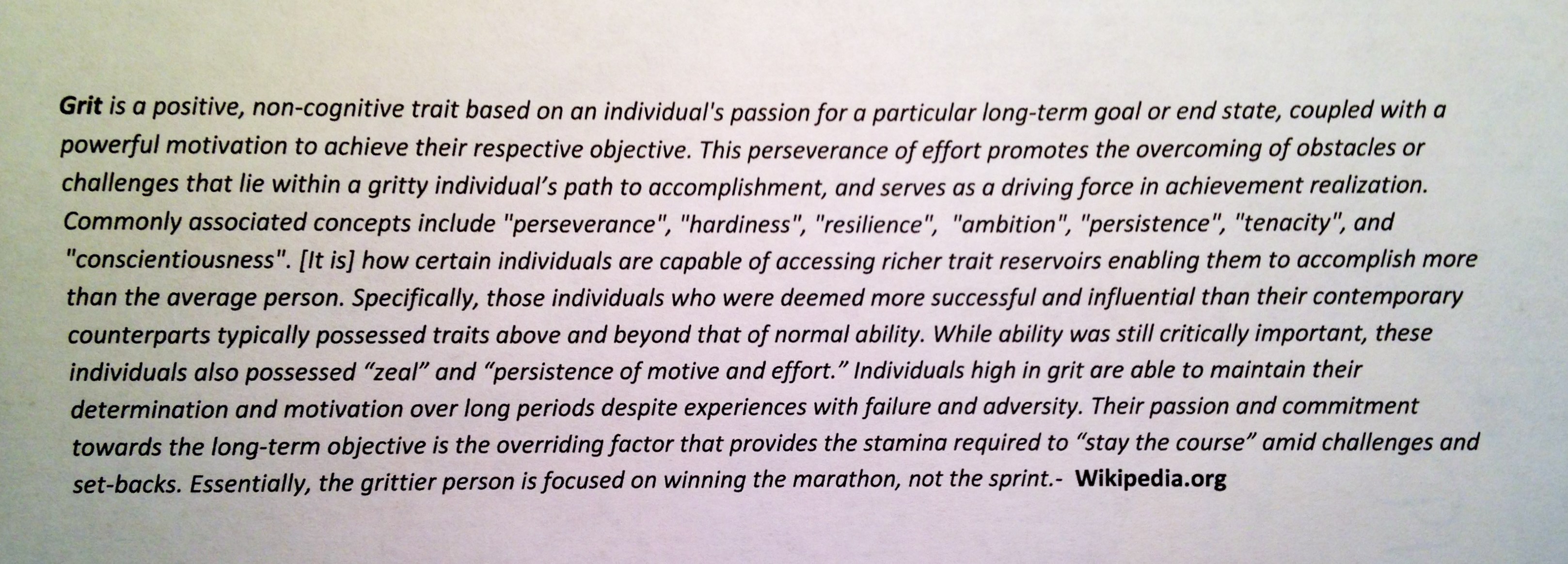
Wikipedia.org defines grit as a character trait  of applying passion and perseverance over time toward a goal, end state or objective. Grit goes beyond ability and can withstand failure, keeping the end goal in sight, and pushing through to it.Blog - Grit - Definition 2

Bill Hybels, at the Global Leadership Summit 2015*, talked about grit as “one of the greatest indicators of success”. Gritty people, he said, are the ones who “play hurt” and rarely ever give up. “They expect progress to be difficult, but believe with their whole being that they can be successful if they don’t quit.” It’s “The Little Engine That Could”. Abraham Lincoln. Nelson Mandela. Gandhi. Martin Luther King. Hybels also encouraged the audience that grit can be developed. From childhood through adulthood.

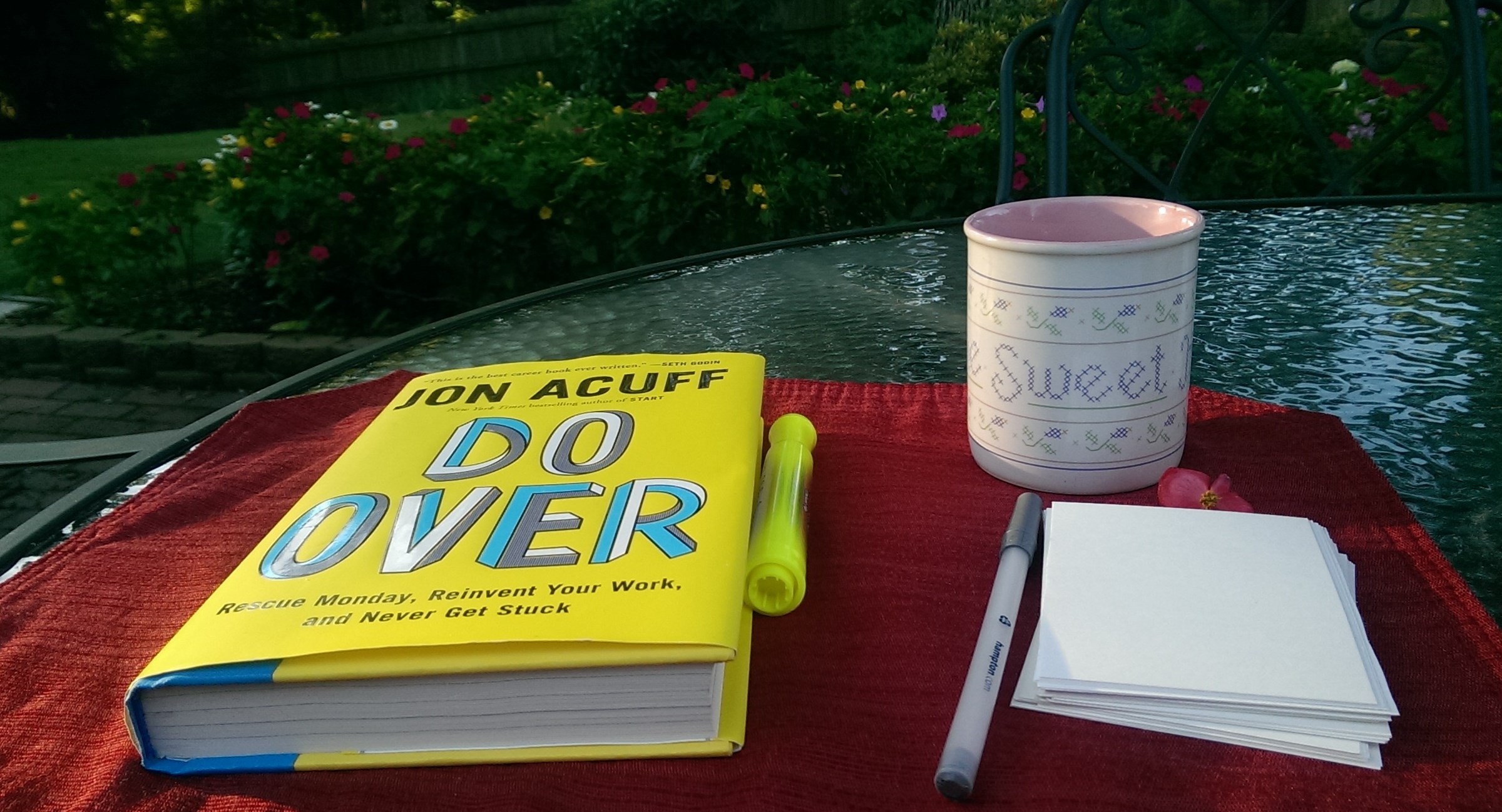
Jon Acuff (author of Do Over) defines grit as “stubbornness in the face of fear“.  In his book, he gives a short list of what’s needed in making gritty decisions (in the “hustle” of work):

  • Time – we think the world “hustle” has to mean fast, but it can also mean focus, intention, pace.
  • Counsel – Lean on your relationships. Some of the worst decisions are made alone. Who are your advocates? Have you given them time to reflect on it or are you rushing right by the wisdom they have to offer? Let them speak into it. A year from now, looking back on the decision, you’ll be glad you made it as a team.
  • Questions – Always ask awesome opportunities, awesome questions. We skimp on due diligence. “What am I not seeing right now?”
  • Kindness – Give yourself permission to make the wrong decision, because…you’re going to. Break the tension of feeling like you’re going to be perfect by giving yourself some kindness from the outset.
  • Honesty – When you look back on a decision, remember that you made that decision with the best information you had at the time.

As we saw those two older heavyset men running just behind their younger airmen colleagues, we saw men with a goal in mind. There was also something more – the cadence to the group’s run that seemed to work to keep them all together. Whether at work or in family relationships, we want to do all we can to help those gritty ones be successful. Their resolve may get them to the goal anyway, but we all benefit when we are able to “stay on course” together.

Have you “grown gritty” over your lifetime? Are there gritty folks in your life who you love to champion? Please share in the Comments below so that we can all learn.

*Session 1: Bill Hybels Opening Session – Global Leadership Summit

Wikipedia Article on Grit

The Truth About Grit

The Grit Test

Jon Acuff on the Role of Hustle in Taking Hold of Career Opportunities – Notes & Quotes – Part 5 of Do Over Series

How to Make Grit Decisions and Built a Grit List by Jon Acuff

Do Over: Rescue Monday, Reinvent Your Work, and Never Get Stuck by Jon Acuff

Does Teaching Kids To Get ‘Gritty’ Help Them Get Ahead?

Monday Morning Moment – When Connections Are Lost – a Rant, a Resolve, and a Request

Photo Credit: Pixabay

Here written is a cautionary tale…one with a happy ending to follow.

Across my professional and personal life, I’ve experienced a great wealth of teams, affinity groups, communities and networks. Real flesh-and-blood people gathered passionately around products or services. People who trusted and enjoyed each other, who used their influence to do good. People who expanded both their influence and ability to do good by holding doors open to others with like vision.

…and I got to be a part of all that. It was an incredible life…and I want it back.

This is not to say that my life is lacking. That’s the rub. Life is amazingly good right where I am…wait for it…but, (such a small word that screams discontent, right?). There is something that has faded, and it can for you as well, if you’re not aware and nurturing it. Don’t let it happen because it’s too valuable.

What I have discovered over the last year is that the wide-reaching, lively connections in my work and personal life have been lost…or, for sure, diminished. This is what I’m determined to correct.

You know that odd experience when you lose a phone conversation (either because of passing through a cell service dead zone or you hit the disconnect button). You or the other person continues talking for a bit not realizing the other person is not listening…has left the conversation (intentionally or not intentionally)…and once re-connected, if you’re able, you have to awkwardly figure out where you left off.

Lost connections are jarring because they interrupt a process of communicating, collaborating or cooperating together on something of value.

Human capital is when you are connected to different individuals who have the capacity and desire to do good together (in creating or innovating – a product or service). Social capital – that of teams, agencies, or other communities working together – is an even larger, richer commodity than individual human capital.

I wrote about social capital previously here.

Social capital is the willingness of people to help each other. It often replaces money which people would use to buy the same help. Most ways of measuring social capital have to do with trust – people who trust that favors and help will be available when they need it will favor and help others more. Social capital is a lot like real capital. The more money a person or a society has, the easier it is to do things and the better off people are.Simple English Wikipedia

Photo Credit: IResearchNet

Through a variety of circumstances in recent years, I have lost some social capital. Reflecting on this real situation has been very helpful and motivating for me personally.

Jon Acuff, in his book Do Over, talks about the importance of not burning bridges when we leave a job or affiliation. I’m a bridge-builder not burner, but bridges can break down, through neglect or vision change and resource realignment.

At times, the sheer force of too much change can cause connections to be lost. Repeated change can lead to chronic states of transition, and we, in those situations, can find ourselves floundering, not sure really what or whom we call team or community.

There’s the regret and the resolve.

After years of living in many countries and working in various roles, we seem settled here in Virginia, at least for now. Still, in the past few years, we have experienced many changes here in work and community affiliations. Change can be so exhausting. It can either galvanize relationships or cause trust to sag a bit…and tempt us to circle the wagons.

I’m resolved to find my way out of this…even at my “old age” and in my semi-retired status…In other words, I have the opportunity AND the resolve.

Just now I’m reading a somewhat dated but still fascinating book on social capital. Written by Tara Hunt it has a curious title: The Whuffie Factor: Using the Power of Social Networks to Build Your Business.

Photo Credit: Amazon

Hunt took that title from a commodity in Cory Doctorow‘s sci-fi novel Down and Out in the Magic Kingdom. In Doctorow’s futuristic setting, “whuffie” was the currency and it was gained by being “nice, networked, and/or notable”. A little simplistic, but I do appreciate Hunt’s 5 principles of building social capital (this in the work world, but it can be applied in other situations as well):

  1. Stop talking and start listening.
  2. Become part of the community you serve and figure out who it is you are serving. [It isn’t everyone.]
  3. Be notable and create amazing experiences/remarkable products for your customers.
  4. Embrace the chaos. Don’t overplan. Learn to be agile. Recognize everyday magic.
  5. Find your higher purpose. Social capital only gains in value as you give it away. Figure out how you are going to give back to the community and do it…often.         – Tara HuntPhoto Credit: Pixabay

7 Ways to Increase Your Whuffie Factor – Tara Hunt – Fast Company

As I keep reflecting on re-building connections,  social capital is now a goal. It may look very different these days than before, but what’s most important is getting back in the game.

Jordan Harbinger, blogger and podcaster for a website called The Art of Charm, has issued a challenge that intrigues me. This social capital challenge is what I need right now. Photo Credit: Screen Shot – Art of Charm

The challenge itself is designed to take a month, and I’ve been sitting on it a month already. Reading books and articles on the topic and avoiding the first challenge – settling on a written goal of improving my social capital (and sharing it publicly).

Next time I write about social capital, it will be with the challenge ON! Here’s my request: it would be so helpful for me (and others) if you shared your experiences or thoughts in this area (via Comments below or in a private email). Don’t let the phrase social capital put you off. Remember it just means working/networking with groups toward something that benefits others. I’ve known the great value of that and want to figure out how to invest like that again.

Let’s shake up the world…for good…together. Game on!

Monday Morning Moment – Social Capital – An Invaluable Resource We Can Develop – and a Tool to Help – Deb Mills Writer

Deep Connections Like These Will Make You Very Influential – Ron Carucci

Social Capital Challenge – The Art of Charm

Jordan Harbinger – The Art of Charm – Twitter

5 Friday Faves – Psychological Tricks, Leadership Hacks, Parenting, Egyptian Food, and Pressing On

Welcome to Friday, Folks! It’s a breezy, warming Spring day. Almost summer. Hope you have a safe and refreshing weekend. Here are five of my favorite finds this week. Please comment below what your favorites are this week. Blessings!

1) Psychological Tricks – Whether we are aware or not, we apply mental processes to our interactions. For better or worse. How we sit in a room, for instance. If we have a problem with someone, we are tempted to sit across from them, rather than beside them. This is actually counter-intuitive because people are less apt to attack the person seated beside them. Another action I’ve learned over the years is to never have a two-on-one difficult meeting. If the meeting requires the presence of three people, the person being disciplined should have one of those persons seated beside him/her, almost as an advocate. The meeting will then be less threatening and potentially more productive. Distractions, like posture and unnecessary verbiage, are easy for us to control with practice.

Photo Credit: The Power of Ideas, Ideapod

Saying “I think” or “I feel” is redundant and draws down the power of the message that follows. Also slumping or folding arms across your chest can communicate something other than your intent and again weakens your message. Communicating effectively is worth the study into our own quirks and applying psychological “tricks”. Not to manipulate but to increase message clarity. An interesting article I discovered this week is 15 Clever Psychological Tricks That Everyone Should Know and Start Using Immediately. Rapid read.

[Sidebar: Don’t be put off by a few grammatical errors. The piece doesn’t appear to be written by a native English speaker.]

2) Leadership Hacks – Two of my favorite leadership coaches are Marcel Schwantes and Carey Nieuwhof. Any of us who truly want to be effective leaders would do well to hear their counsel. Schwantes has written a piece entitled: To Be a Strong Leader, There Are 6 Things You Must Give Your People (Most Rarely Do). He delineates what strong leaders give their employees:

  • They give employees their ear.
  • They give employees empathy.
  • They give employees rewards and recognition.
  • They give employees space to recharge.
  • They give employees plenty of information communicating both the good and the bad.
  • They give employees fairness.

Photo Credit: Flickr

Click here for Schwantes’ commentary on each. Leaders too often think they do well in these areas and thus do not discipline themselves to keep tooled. Unfortunately, if not checked,  weaknesses in these areas will permeate a company.

Nieuwhof posted about a growing problem in leadership – Why Busy Leaders Make Bad Leaders. We expect to be busy as leaders because we have loads of responsibility. So why is it that some leaders seem to have the time to be the kind of leader Schwantes notes in his article above? Leaders who delegate and don’t need to control processes or employees are those who most see the value of employees and their impact on the product and customer satisfaction. Read his article linked above. Here is how he closes:

Busy people love to act like they have no choice and they’re oh-so-slammed. Until you catch them binge watching Netflix, or lingering over an iced coffee checking Instagram, or talking for 30 minutes at a workmate’s desk about nothing in particular.

I’m not trying to be judgmental. I’m all for iced coffees and Instagram. It’s just there’s a cognitive dissonance in many of us between what we believe and what’s true.

You have the time for what matters. After all, every leader gets 24 hours in a day. You have the time to get the most important things done. You just didn’t make the time—you spent it doing something else.Carey Nieuwhof

3) Parenting – Parenting is a tough job and advice abounds. I am cautious in recommending parenting books and articles because the sense of guilt for parents is already sizable. Every child is different and every situation is as well. Having said all that, I do see hope in simplifying one’s family life and environment…just so both the parent AND the child can breathe.Photo Credit: Simplicity Parenting

Kim John Payne is a writer, researcher, and speaker in the field of simplicity parenting. Having spent over two decades in the school and family counseling field, he has seen the chaotic nature of family lives and its impact on children. His book  Simplicity Parenting: Using the Extraordinary Power of Less to Raise Calmer, Happier, and More Secure Kids is a best-seller. I have not yet read his book but have already been captivated by his teaching on his website.

If all we do is throw away toys as a way to simplify our children’s lives, we are not really dealing with the issue of chaos in their lives. Too often, we replace material possessions with the pursuit of experiences (what we may call social, athletic, or academically enriching). Experiences, especially where our children learn to serve and value others, can be life-transforming. However, we must be careful that experiences don’t continue to cause our littles to be over-stimulated making them addiction-prone in later years. Needing more, more, more to be satisfied.

Check out Payne’s website, and listen to his lectures both on his website and YouTube. I love when parents write comments (on Amazon reviews, for instance). Some have experienced his prescriptions as heavy and guilting, creating their own form of chaos. The major take-away of all parenting advice must be what speaks to you and your child’s situation. The rest is its own clutter.

YouTube Video – LoveParenting: Simplicity Parenting – Which Toys to Get Rid Of (Minimalistic Approach to Play)

YouTube Video – LoveParenting: Minimalism – the only 10 TOYS you “need”

According to Harvard Psychologists – Parents Who Raise “Good” Kids Do These Five Things

The Silent Tragedy Affecting Today’s Children

YouTube Video – Raising Children – Jeff Foxworthy

4) Egyptian Food – I’ve spent the last several days in the home of a very good Egyptian friend. She is an incredible cook. Egyptians are known for their hospitality and it was lavished on me in that visit. We had many of my favorite Egyptian foods, and my friend is an outstanding cook. In celebration of that, I wanted to extend to you the recipes of three of those dishes: Macarona Bechamel, Koshari (or Kushary), and Basboosa.

Macarona Bechamel

KoshariPhoto Credit: Wikimedia

Basbousa (Coconut Yogurt Semolina Cake)Photo Credit: Flickr

5) Pressing On – A friend of ours, Marlo Salamy, writes a blog about life, God, and her family following the death of their youngest, Anna, to cancer in 2007. I’m always touched by the honesty and faith reflected in her writing. In this week’s blog, What Matters, she writes about how we might act in the potential lost moments of our lives. Her illustration is from the tornado that blasted through Joplin, Missouri, when over 100 people lost their lives on May 22, 2011. The video posted in the blog makes you think. Wow!

YouTube Video – Aftermath of First Person Joplin Tornado (shown above in Marlo Salamy’s blog) – https://www.youtube.com/watch?v=W-P4P68YyNM

Bonus: Spotlight Syria

https://www.youtube.com/watch?v=W_6aXNB77us or https://www.facebook.com/ajplusenglish/videos/966031366871704/